
Form Fill Seal (FFS) Medical Packaging
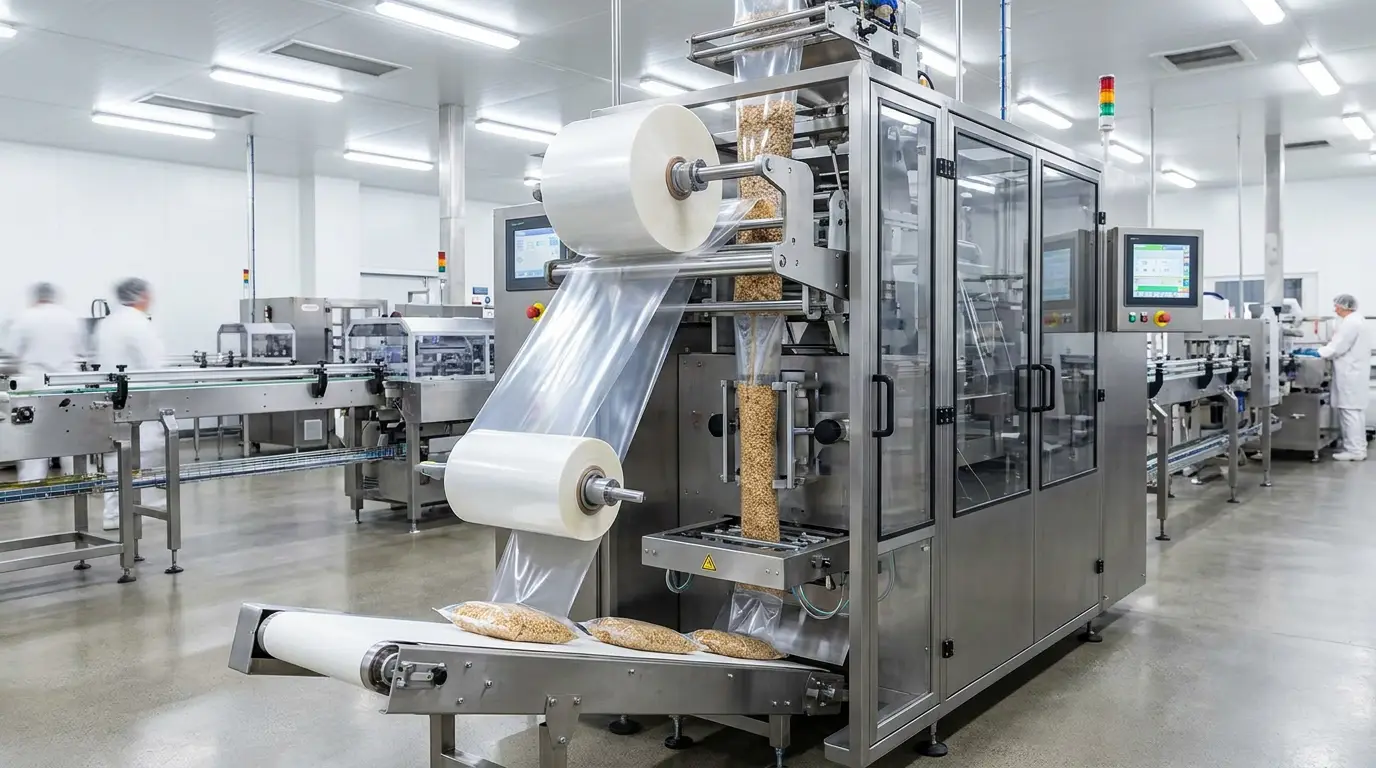
Form Fill Seal Packaging for Medical Products
High-speed, validated FFS systems for sterile medical device and pharmaceutical packaging at industrial scale
Form Fill Seal Technology in Medical Packaging
Form Fill Seal (FFS) is a fully automated packaging process that forms the package, fills it with the product, and seals it in a single continuous operation. In medical packaging, FFS lines produce pouches, sachets, and pillow packs for surgical instruments, wound care products, catheters, infusion sets, and pharmaceutical products.
FFS machines operate in two primary configurations: Vertical FFS (VFFS) for powders, liquids, and granular products, and Horizontal FFS (HFFS) for medical devices, surgical kits, and solid products requiring precise placement. HFFS is the dominant configuration in sterile medical packaging as it allows controlled product loading in clean room environments.
For medical device manufacturers, FFS offers a compelling combination of packaging speed (hundreds of units per minute), tight dimensional consistency, and compatibility with validated seal parameters under ISO 11607-2.
FFS Film Materials for Medical Applications
Film selection for medical FFS packaging must balance barrier performance, sealability, sterilisation compatibility, and mechanical strength during processing. Common structures include:
- Tyvek / PE laminate — ETO-compatible; Tyvek face provides microbial barrier with visible peelable opening
- Paper / PE laminate — Cost-effective alternative to Tyvek for lower-specification sterile pouches
- PET / PE or PET / PP — Transparent structures for gamma and e-beam compatible pouches
- Nylon / PE laminates — Superior puncture and abrasion resistance for sharp instruments and implants
- Foil laminates — Hermetic barrier for highly moisture-sensitive or light-sensitive products
Clean Room Integration and Aseptic FFS
Medical device FFS lines are typically installed within ISO Class 7 or 8 clean rooms (equivalent to EU GMP Grade C/D). The filling zone may be further isolated under a LAF (Laminar Air Flow) hood to maintain ISO Class 5 conditions where required for high-risk devices or aseptic pharmaceutical manufacturing.
Aseptic FFS systems integrate sterilisation of the packaging film (typically H₂O₂ vapour or UV treatment) and fill the product within the sterile envelope before final sealing. This approach is used for liquid pharmaceuticals, biologics, and devices that cannot be terminally sterilised after packaging.
Qualification of clean room FFS lines includes HVAC validation, particle count monitoring, environmental monitoring during production, and media fills for aseptic process confirmation — all documented within the site's QMS per ISO 13485:2016.
Process Validation for Medical FFS Packaging
ISO 11607-2 requires full process validation for any FFS sealing process used on sterile medical packaging. The validation programme typically includes:
- Seal parameter characterisation (temperature, pressure, dwell time) across worst-case film lot variability
- Sealing process IQ/OQ/PQ with statistical sampling per ASTM F2097 guidance
- Seal integrity testing per ASTM F1929 (dye) or ASTM F2096 (bubble), and seal strength per ASTM F88
- Package integrity post-sterilisation and post-distribution simulation (ASTM D4169)
- Accelerated ageing per ASTM F1980 plus real-time confirmation studies
Frequently Asked Questions
Vertical FFS (VFFS) forms a tube from film, fills through the top, and seals horizontally — suited for powders, granules, and liquids. Horizontal FFS (HFFS) unwinds a flat film web horizontally, thermoforms a bottom cavity, loads the product, and seals a top web — preferred for medical devices as it allows controlled placement. HFFS is the dominant configuration in sterile device packaging.
Yes, when the pouch includes a breathable face material such as Tyvek or medical-grade paper. The porous material allows ETO gas penetration while maintaining the microbial barrier. The sealing parameters must be validated to ensure the Tyvek-to-film seal achieves the required strength without damaging the Tyvek structure.
ISO Class 7 (US FED STD 209E Class 10,000 equivalent) is the minimum typically specified for sterile medical device packaging filling areas. The filling/loading zone directly exposed to the open package is often held to ISO Class 5. For aseptic pharmaceutical manufacturing, EU GMP Grade A (ISO Class 5) with Grade C/D background is required.
Production seal monitoring includes 100% seal inspection via vision systems (checking for wrinkles, missing seals, foreign material in the seal area), periodic peel strength testing on production samples per ASTM F88, and regular product integrity testing. Any out-of-specification result triggers a non-conformance investigation and batch review.
ISO 11607-2 validation documentation includes: validation plan, equipment qualification protocols and reports (IQ/OQ/PQ), seal parameter studies, seal strength test data, integrity test data, ageing studies, distribution simulation reports, and a final validation report. All documents must be version-controlled and retained within the DHF.
FFS Packaging for Medical DevicesDiscuss FFS line integration, film selection, and full ISO 11607 validation support with our experts.
Contact Us →