
Cold Chain Packaging for Biologics & Vaccines
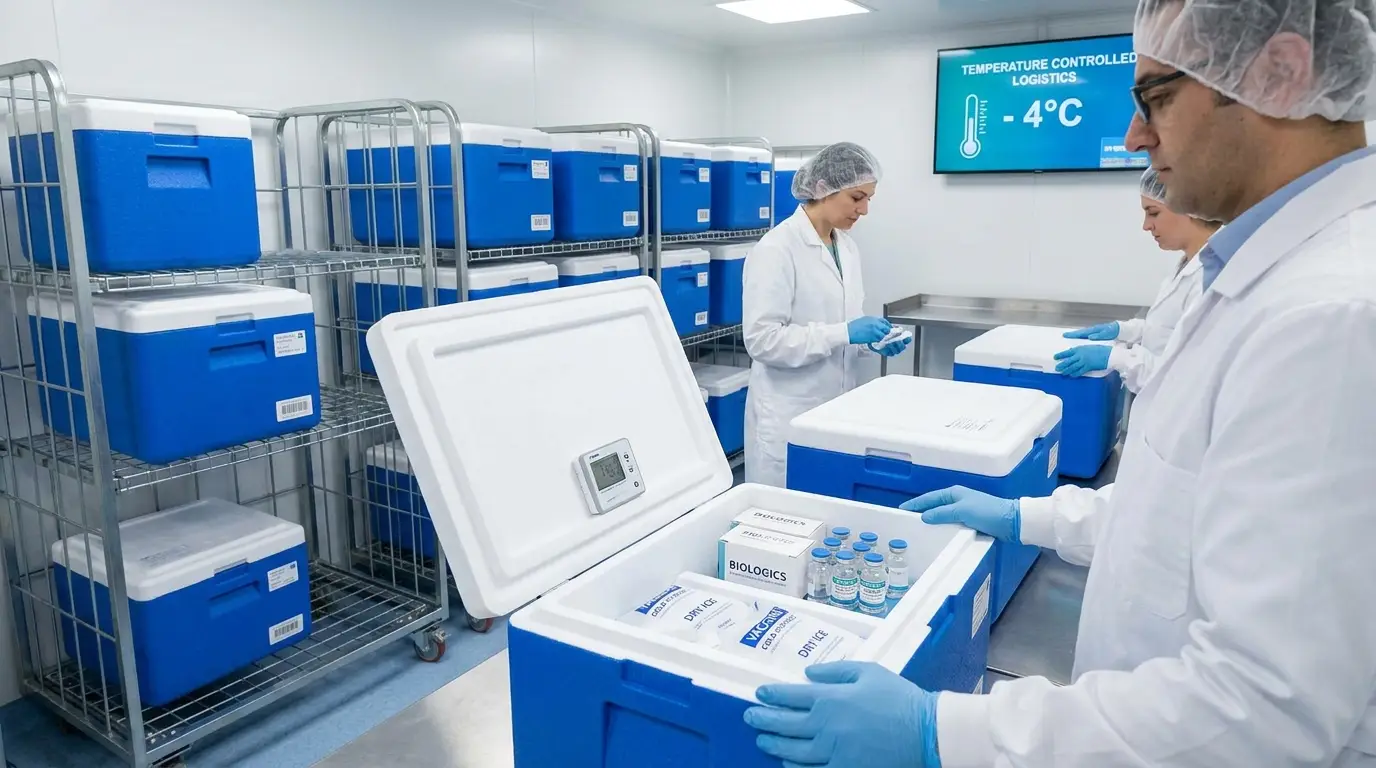
Cold Chain Packaging for Biologics, Vaccines and Medical Devices
Temperature-controlled packaging solutions that maintain 2–8°C, controlled room temperature, and ultra-cold conditions for biologics, vaccines, diagnostics, and temperature-sensitive medical products
What Is Cold Chain Packaging for Medical Products?
Cold chain packaging refers to the insulated, temperature-controlled packaging systems used to maintain medical products within their required temperature range from manufacturer to end user — through storage, distribution, customs handling, and last-mile delivery. It is a critical subsystem of the broader cold chain logistics network, alongside temperature-controlled warehousing, refrigerated transport, and real-time monitoring.
The pharmaceutical and medical device sectors have the most demanding cold chain requirements of any industry. Products range from vaccines and monoclonal antibodies requiring 2–8°C refrigerated storage, to frozen biologics and plasma at −20°C, to cell and gene therapies requiring cryogenic conditions at −80°C or below. GLP-1 agonists (such as semaglutide and liraglutide), one of the fastest-growing pharmaceutical categories, require validated 2–8°C cold chain throughout distribution.
Cold chain packaging failures — temperature excursions — can destroy product efficacy, trigger costly investigations, and — for vaccines and critical biologics — represent direct patient safety risks. The packaging system must be designed, tested, and qualified to provide adequate thermal protection across the worst-case environmental and transit conditions for the intended distribution profile.
Market Context: The global pharmaceutical cold chain logistics market exceeded USD 25 billion in 2025 and is growing at 8–10% annually, driven by the rapid expansion of biologics, cell therapies, mRNA vaccines, and GLP-1 pharmaceuticals — all of which require validated cold chain packaging.
Cold Chain Temperature Ranges and Product Categories
Refrigerated (2–8°C / CRT 15–25°C)
The 2–8°C range is the most common cold chain specification, covering insulin, vaccines (MMR, influenza, HPV), monoclonal antibodies, blood products, and most liquid biologics. Controlled Room Temperature (CRT / 15–25°C) products include many oral pharmaceuticals and certain diagnostic reagents that must be protected from heat but do not require active refrigeration. CRT packaging protects against temperature spikes during transit — particularly important in summer distribution and air freight scenarios.
Frozen (−20°C)
Frozen storage is required for plasma, many vaccines (varicella, some influenza formulations), and frozen diagnostic specimens. Packaging at −20°C must maintain the product frozen throughout the distribution journey, using dry ice, phase change materials (PCMs), or active refrigeration systems.
Ultra-Cold (−80°C and below)
Cell and gene therapies, mRNA vaccines (including certain COVID-19 formulations), and cord blood products require ultra-cold conditions achievable only with dry ice (−78.5°C sublimation point) or liquid nitrogen (−196°C). Ultra-cold packaging uses dry ice-filled EPS (expanded polystyrene) or vacuum insulated panels (VIP) in validated shipper configurations, with payload monitoring via electronic data loggers.
Cold Chain Packaging Systems and Components
Insulated Shippers
Insulated shippers are the core cold chain packaging unit — an outer corrugated carton lined with insulation (EPS foam, moulded pulp, or VIP panels) and containing a coolant payload (gel packs, PCM panels, or dry ice). Shipper performance is characterised by its ability to maintain the product temperature for a defined duration (e.g. 48, 72, or 96 hours) across summer and winter ambient temperature profiles.
Phase Change Materials (PCMs)
PCMs are materials engineered to absorb or release large amounts of thermal energy as they transition between solid and liquid states at a specific temperature. For 2–8°C applications, water-based gel packs (0°C PCM) pre-conditioned to the correct state are the most common. For higher temperature targets (15–25°C CRT), organic PCMs with melting points of 15°C or 22°C are used. PCMs are reusable and offer more predictable performance than dry ice.
Vacuum Insulated Panels (VIPs)
VIPs achieve thermal resistance values 5–10× greater than EPS foam at equivalent thickness, enabling thinner, lighter, higher-performance shippers. They are particularly valuable for air freight applications where dimensional weight charges penalise bulky EPS designs. VIPs are more expensive than EPS and can be punctured (destroying insulation performance), requiring careful handling protocols.
Temperature Monitoring and Data Loggers
Electronic temperature data loggers (single-use or reusable) are placed inside the shipper at payload level and record temperature at defined intervals (typically 1–5 minutes) throughout the shipment. On arrival, the log is downloaded and reviewed against the product's temperature excursion policy. Connected loggers with cellular or GPS capability provide real-time visibility and automated alerts for excursions in transit.
Regulatory Requirements: GDP, ICH Q1A, and WHO Guidelines
Cold chain packaging for pharmaceutical products must comply with multiple regulatory frameworks:
- EU GDP (Good Distribution Practice): EU Guidelines 2013/C 68/01 require that temperature-sensitive products be stored and transported under appropriate conditions, with qualified equipment, temperature mapping, and excursion management procedures
- WHO Technical Report Series: WHO TRS 961 Annex 9 provides guidelines for the storage and transport of time- and temperature-sensitive pharmaceutical products
- ISTA 7D: The International Safe Transit Association's ISTA 7D protocol is the primary qualification standard for thermal shipper performance testing — the industry benchmark for pharmaceutical cold chain packaging qualification
- ICH Q1A(R2): Stability testing guidelines that define the temperature and humidity conditions products must be tested under, informing the cold chain requirements for distribution
- EU MDR: For medical devices requiring cold chain storage, temperature requirements must be documented in the Instructions for Use (IFU) and the device's technical file
Frequently Asked Questions
Passive cold chain packaging relies on insulation and pre-conditioned coolants (gel packs, dry ice, PCMs) to maintain temperature — no external power required. Active systems use thermoelectric or refrigerant-based units powered by electricity or battery. Passive systems are used for most pharmaceutical distribution shippers (1–5 day journeys); active systems are used for fixed refrigerated containers in road and air freight for longer routes or larger payloads.
Shipper qualification uses the ISTA 7D protocol, which tests the shipper's thermal performance against defined ambient temperature profiles (summer: 38°C peak; winter: −20°C peak) over the required hold duration (e.g. 48, 96, or 120 hours). The test uses a calibrated thermal payload chamber, data loggers at multiple positions, and runs multiple replicates. Results must demonstrate that the payload stays within the target temperature range throughout the worst-case test scenario.
Temperature loggers must meet calibration requirements per ISO/IEC 17025-accredited laboratories. GDP guidelines require documented calibration with traceability to national standards. For critical products, EN 12830 (temperature recorders for transport and storage) defines minimum performance requirements. Single-use loggers are common for last-mile distribution; reusable loggers with cloud connectivity are used for high-value shipments requiring real-time visibility.
The fundamental requirements are the same — validated packaging, temperature monitoring, GDP compliance — but vaccines have additional requirements under WHO and national immunisation programme guidelines. WHO's Vaccine Cold Chain Equipment Optimization Platform (VCCEP) and PQS (Prequalification of Vaccines) programmes specify performance requirements for vaccine carriers and cold boxes used in global immunisation logistics, including solar-powered cold rooms for last-mile in low-resource settings.
A temperature excursion is any period during which a product's temperature falls outside its defined storage range. Management requires a documented excursion policy covering: immediate quarantine of affected product, temperature log retrieval and review, stability data assessment (using the Mean Kinetic Temperature calculation per ICH Q1A), and a disposition decision (release, reject, or additional testing). All excursions must be documented as deviations within the QMS.
Cold Chain Packaging SolutionsDiscuss shipper qualification, PCM selection, and GDP-compliant cold chain packaging for your product.
Contact Our Team →