
Pharmaceutical Packaging: Primary, Secondary & GMP
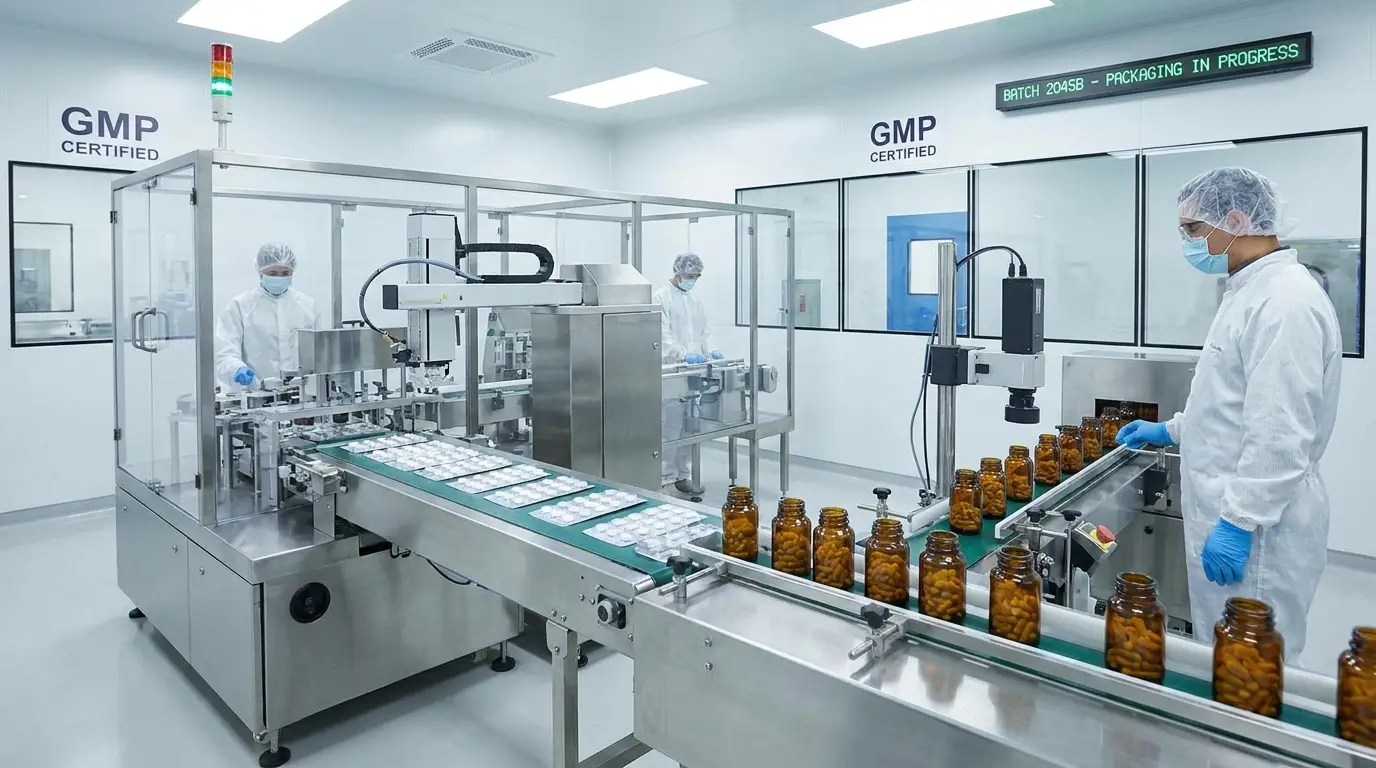
Pharmaceutical Packaging: Primary, Secondary and Tertiary Systems
Complete guide to pharmaceutical packaging formats, GMP requirements, serialisation, and EU pharmaceutical legislation compliance for drug manufacturers
Pharmaceutical Packaging: Definition and Scope
Pharmaceutical packaging encompasses all materials and systems used to contain, protect, identify, and deliver medicinal products from manufacture to patient. It is regulated as an integral component of the drug product — changes to packaging materials require regulatory notification or approval, and packaging materials that come into contact with the drug substance (primary packaging) are subject to the same quality and safety standards as the drug itself.
Packaging is divided into three levels: primary packaging (in direct contact with the drug product — blister films, vial closures, syringe barrels), secondary packaging (cartons, labels, patient information leaflets), and tertiary packaging (outer transport cases, pallets). Each level has distinct regulatory, quality, and functional requirements.
For the pharmaceutical industry, packaging is not merely a container — it is a critical quality system. The ICH Q8, Q9, Q10, and Q11 guidelines frame packaging within the pharmaceutical quality system, and all packaging components for marketed drugs must be documented in the Pharmaceutical Dossier (CTD Module 3 for EU, NDA/ANDA for FDA).
Primary Pharmaceutical Packaging Formats
Blister Packs (Oral Solid Dosage)
Blister packaging is the dominant primary format for tablets and capsules. Thermoformed PVC/PVDC (high moisture barrier), PVC/Aclar (ultra-high barrier), or cold-formed aluminium foil (hermetic barrier) cavities are sealed with printed aluminium foil lidding. See our full Blister Packaging guide. Blister packs provide unit-dose control, tamper evidence, and patient compliance support through calendar-format pack designs.
Glass and Plastic Vials (Injectable)
Sterile injectable pharmaceuticals use Type I borosilicate glass vials (highest chemical resistance) or cyclic olefin polymer (COP/COC) plastic vials as primary containers. Vials are closed with bromobutyl or chlorobutyl rubber stoppers and aluminium crimp seals. Primary container compatibility must be established through extractables and leachables (E&L) studies per ICH Q3C, Q3D, and EMA guidelines.
Prefilled Syringes
Prefilled syringes (PFS) are growing rapidly, driven by biologics and self-injection devices (auto-injectors for GLP-1, insulin, TNF inhibitors). Borosilicate glass or COP barrels, siliconised plungers, and fluoropolymer-coated needle shields constitute a complex primary container closure system requiring full compatibility, functionality, and sterility validation. Tungsten contamination from barrel forming is a specific concern for protein biologics.
Pouches and Bags (Large Volume Parenterals)
IV fluids, TPN bags, and dialysis solutions use multi-layer flexible plastic bags (PP/PE, EVA/PP) as primary containers. These large-volume parenterals (LVPs) require sterilisation by autoclaving after filling — placing thermal stability requirements on both the drug product and the container material.
EU Pharmaceutical Packaging Regulations
Pharmaceutical packaging in Europe is governed by a dense regulatory framework:
- EU Directive 2001/83/EC (as amended): The primary pharmaceutical legislation, including requirements for packaging and labelling of medicinal products for human use. Annex I defines the format and content of the Summary of Product Characteristics (SmPC) and Patient Information Leaflet (PIL).
- EU GMP Guidelines Annex 1 (2022): The revised Annex 1 on manufacture of sterile medicinal products significantly strengthens contamination control requirements, with direct implications for aseptic primary packaging operations and container closure integrity testing (CCIT).
- EU Falsified Medicines Directive (FMD) / Delegated Regulation 2016/161: Requires all prescription medicines sold in the EU to carry a 2D DataMatrix serialisation code and tamper-evident feature on the outer packaging. Manufacturers must upload serial numbers to the European Medicines Verification System (EMVS) before release.
- EU PPWR: The Packaging and Packaging Waste Regulation applies to pharmaceutical secondary and tertiary packaging with phased recyclability requirements — primary packaging may qualify for exemptions based on safety requirements.
Serialisation and Track-and-Trace
The EU Falsified Medicines Directive mandates that pharmaceutical secondary packaging carries a unique serial number encoded in a 2D DataMatrix code, along with a human-readable string containing product code, batch number, expiry date, and serial number in the format defined by ISO/IEC 15418 and GS1 standards. Tamper-evident features must be incorporated into or applied to the carton.
Implementation requires integration of serialisation systems across packaging lines, with connectivity to site-level aggregation (item → case → pallet) and national verification system reporting. Pharmaceutical manufacturers supplying the EU market must be connected to the EMVO/EMVS infrastructure.
Frequently Asked Questions
Primary packaging is in direct contact with the drug product — the blister film and foil, vial, syringe, or pouch containing the medicine. Secondary packaging is the outer layer that does not contact the drug — cartons, labels, patient information leaflets, and multi-unit containers. Primary packaging is subject to strict material qualification, extractables/leachables testing, and compatibility studies. Secondary packaging carries the regulatory labelling, serialisation, and patient information requirements.
Extractables are chemical compounds that can be removed from packaging materials under aggressive laboratory conditions. Leachables are the subset of extractables that actually migrate into the drug product under normal storage conditions. E&L testing is required for all primary pharmaceutical packaging materials that contact the drug substance — characterising the chemical entities, quantifying them, and assessing their toxicological risk per ICH Q3C (residual solvents) and Q3D (elemental impurities) guidelines and EMA guidance documents.
The FMD mandatory safety features (serialisation + tamper evidence) apply to all prescription medicines in the EU, with limited exemptions (certain hospital-exempt products, radiopharmaceuticals). OTC medicines are exempt unless listed on a national register of products at risk of falsification. Non-prescription medicines may voluntarily carry the safety features. All prescription packs placed on the EU market must be verified and decommissioned at point of dispensing.
EU GMP Annex 1 (Manufacture of Sterile Medicinal Products), revised in 2022, is the primary document. It covers contamination control strategy, cleanroom classification (ISO 5/6/7/8 for different operations), environmental monitoring, sterilisation validation, container closure integrity, and process simulation (media fills). Aseptic primary packaging operations (filling lines, vial capping, syringe assembly) fall under Annex 1 Grade A/B requirements.
Compatibility validation involves accelerated and long-term stability studies (ICH Q1A) where the drug product is stored in the proposed primary packaging at defined temperature/humidity conditions and assessed for physical, chemical, and microbiological changes at defined timepoints. Extractables from packaging materials are characterised separately (forced extraction studies), and leachables in the drug product at stability timepoints are measured against the established Analytical Evaluation Threshold (AET) per ICH M7 and risk-based safety thresholds.
Pharmaceutical Packaging ExpertiseDiscuss primary container selection, GMP compliance, serialisation integration, and EU regulatory requirements for your drug product.
Contact Us →