
Medical Packaging Integrity Testing: Methods & Standards Guide
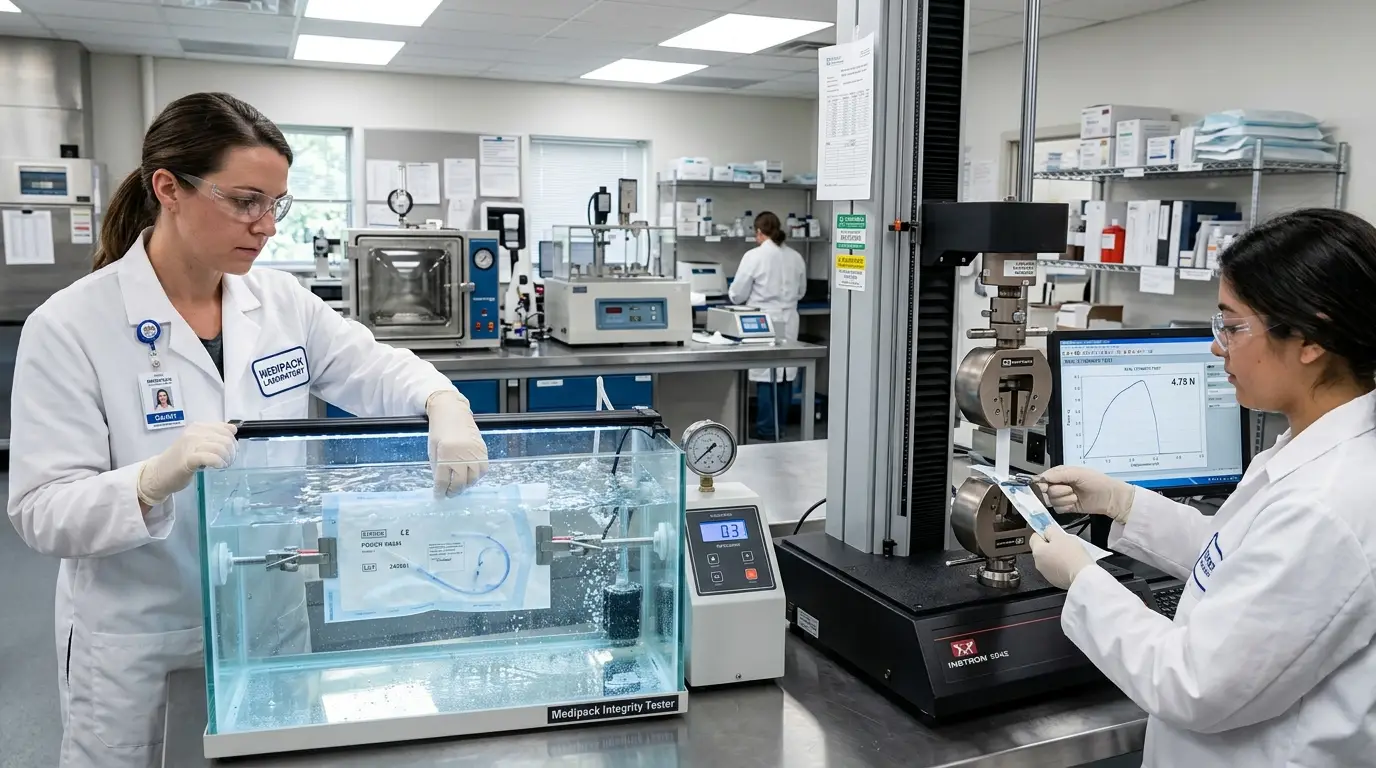
Medical Packaging Integrity Testing: Methods & Standards Guide
Package integrity testing is the primary evidence that a sterile barrier system maintains its protective function from manufacturing through to the point of use.
Why Integrity Testing Matters
A sterile barrier system that loses integrity — through a seal defect, film puncture, or microbial ingress pathway — compromises device sterility and directly endangers patients. Unlike many quality attributes, packaging integrity failure is not detectable at point of use: a pouch that appears intact may have a 50 µm channel through the seal that is invisible to visual inspection but permits microbial ingress. Validated integrity test methods with defined detection limits provide the statistical confidence that the SBS performs its protective function.
Primary Integrity Test Methods
Dye Penetration Test (ASTM F1929)
A validated colorimetric test where aqueous methylene blue dye solution is introduced inside the package under vacuum, then the exterior seal area is inspected for dye penetration. Detection limit approximately 50 µm. Advantages: inexpensive, no special equipment, easy to perform, good sensitivity for seal channel defects. Limitations: destructive test, subjective visual assessment (requires operator training and calibration), not suitable for opaque packaging or packages that cannot withstand vacuum manipulation.
Vacuum Decay Test (ASTM F2338)
A non-destructive integrity test where the package is placed in a sealed test chamber evacuated to a defined vacuum level. The pressure in the chamber is monitored over time — a package with a leak causes measurable vacuum decay. Detection limit 5–10 µm depending on package configuration and test parameters. Advantages: non-destructive (package can be released if pass), objective instrument measurement, suitable for routine in-process and release testing. Requires validated test method development per ASTM F2338 for each package configuration.
Bubble Emission Test (ASTM F2096)
The package is pressurised internally (typically 6–14 kPa) and submerged in water — bubble streams indicate leak locations. Detection limit approximately 250 µm — less sensitive than dye penetration or vacuum decay. Advantages: low cost, provides leak location information, suitable for large packages or where other methods are impractical. Limitations: destructive (package is wetted), relatively poor sensitivity, may not detect slow leaks at maximum test pressure. Used for coarse screening and leak location rather than definitive integrity confirmation.
CO2/He Trace Gas Leak Detection
Trace gas methods (CO2 headspace analysis per ASTM F2714, or helium leak detection) provide the highest sensitivity available — capable of detecting leaks down to 0.1 µm for helium methods. CO2 headspace analysis is suitable for MAP or CO2-flushed medical packaging. Helium leak detection is used for the most demanding applications where sub-micron leak detection is required. Both methods require purpose-built instrumentation and validated test protocols per package configuration.
Seal Strength Testing for Medical Packaging
| Test Method | Standard | Applicable Package Type | Output |
|---|---|---|---|
| Peel test (90°) | ASTM F88 / EN ISO 11607 | Pouches, lidded trays | Peel force N/15mm or N/25mm |
| Burst test (restrained plate) | ASTM F2054 | Pouches, bags | Burst pressure (kPa) |
| Burst test (inflation) | ASTM F1140 | Pouches, sachets | Burst pressure or creep pass/fail |
| Tensile seal strength | ASTM F88 (180° peel) | Peelable and non-peelable seals | Max and mean peel force profile |
Integrity Testing During Validation vs. Routine Production
Integrity testing plays different roles at different stages of the packaging lifecycle. During design validation and process qualification (PQ), integrity testing is performed at worst-case process conditions to demonstrate the SBS can withstand the full distribution environment — typically including distribution simulation (ASTM D4169 or ISTA) followed by integrity testing. During routine production, integrity testing (typically dye penetration or vacuum decay on sampled packages) monitors that the validated process remains in control. The sampling frequency and sample size for routine testing should be defined based on process capability data from the validation and ongoing SPC charts.
Frequently Asked Questions
Which integrity test method should I choose for Tyvek pouches?
Dye penetration (ASTM F1929) is the most widely used method for Tyvek pouch integrity testing and is well-accepted by regulatory authorities as a validated integrity test. Vacuum decay (ASTM F2338) is increasingly adopted because it is non-destructive and provides objective pass/fail criteria without the subjectivity of visual dye inspection. The choice depends on throughput requirements (non-destructive vacuum decay allows release of tested packages), available equipment, and whether the application requires the higher sensitivity that vacuum decay provides. Both methods are referenced in ISO 11607-1 and are acceptable for design validation and routine testing when properly validated for the specific package configuration.
Can integrity testing replace sterility testing?
No — integrity testing and sterility testing are complementary, not interchangeable. Sterility testing (USP 71 / EP 2.6.1) tests whether the product itself is sterile by challenging a sample in growth medium. Integrity testing demonstrates that the sterile barrier was maintained (no physical pathway for contamination). The widely accepted scientific principle that a package with demonstrated integrity — validated SBS, validated sterilisation, validated integrity testing — provides sterility assurance without sterility testing of each unit is expressed in ISO 11607-1. However, sterility testing of finished product may still be required by specific regulatory requirements or product standards even where integrity testing is performed.
What validation is required for an integrity test method?
Before an integrity test method is used as a release or acceptance test, it must be validated for the specific package configuration. Method validation for an integrity test includes: determination of the detection limit (what size of controlled defect does the method reliably detect), repeatability and reproducibility (method precision), positive and negative control confirmation, and any operator training and calibration requirements. Method validation documentation must be in place before the method is used for PQ testing or routine production release. ASTM F2338 Annex A provides guidance on vacuum decay method validation specifically.