
Medical Packaging Thermoforming Tooling
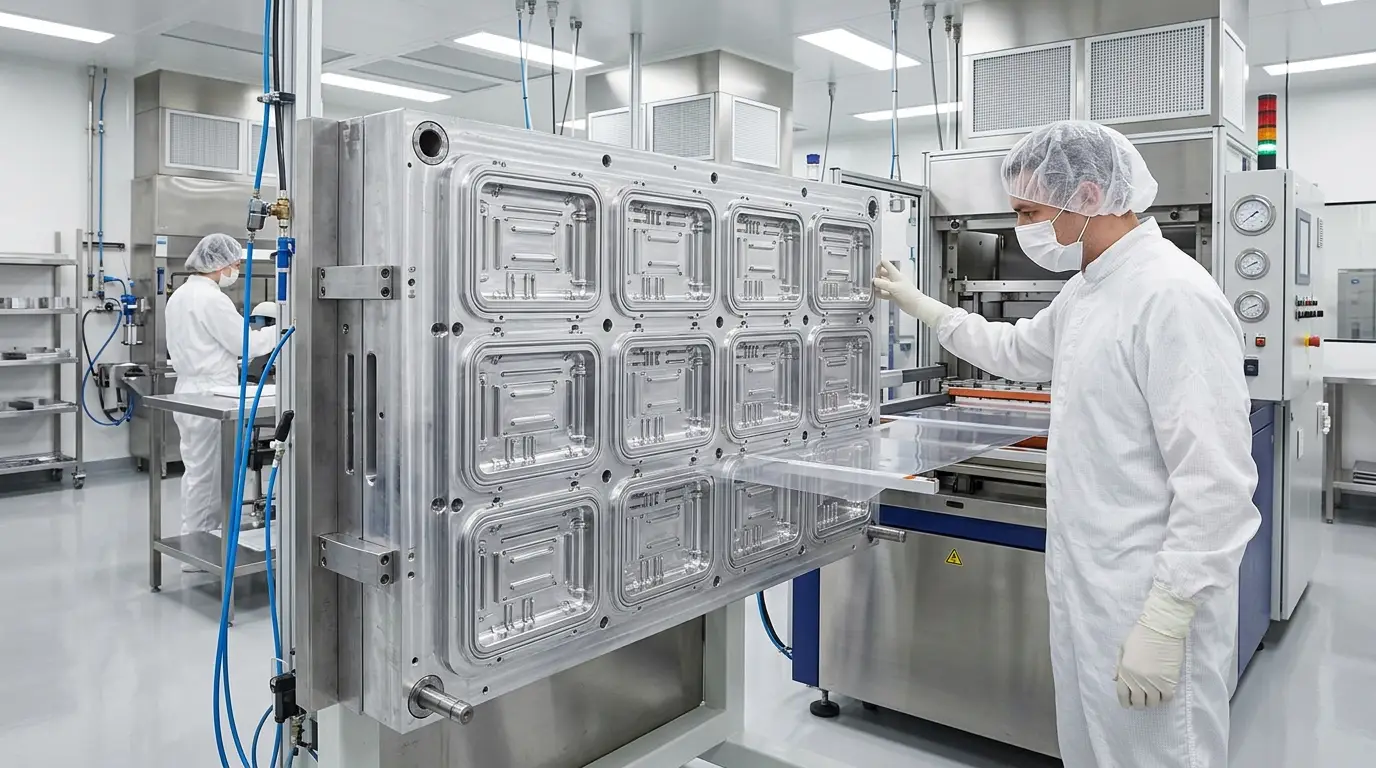
Medical Packaging Thermoforming Tooling
Thermoforming tooling for medical device trays must be designed for cleanroom compatibility, validated performance, and documented traceability from first sample to end of service life.
Thermoforming in Medical Device Packaging
Rigid thermoformed trays are the dominant primary packaging form for medical devices — from single-use surgical instruments to orthopaedic implants. The tray provides device containment, physical protection, and — in the sterile barrier system — the lower web that combined with a Tyvek or film lid creates the hermetic enclosure required for sterile presentation. The thermoforming tool directly determines tray dimensional accuracy, wall thickness distribution, and sealing flange flatness and width — all critical for sterile barrier integrity.
Medical Thermoforming Tool Design Requirements
Cleanroom-Compatible Materials
Tools used in ISO Class 7/8 cleanrooms must be manufactured from materials that do not shed particulates or generate outgassing. Hard-anodised aluminium alloy (6061/7075) is standard — the hard anodised surface provides wear resistance while aluminium provides thermal conductivity for rapid uniform cooling. All internal cooling channels must be polished and flushed; stainless steel fittings are used for all connections to prevent corrosion particulates.
Sealing Flange Precision
The sealing flange is the most critical dimension on a medical device tray. Flange flatness should be controlled to ±0.1 mm across the full perimeter. Minimum flange width is typically 6 mm for Tyvek lidding, 8 mm for film-to-film seals, with additional width at corner radii where peel forces are highest. Surface finish Ra ≤ 1.6 µm on the flange face prevents seal pattern interference.
Device Fixturing Geometry
Medical device trays must hold devices securely in a defined orientation to prevent movement during distribution testing (ASTM D4169/ISTA 2A) and to support consistent aseptic presentation. Tool cavity geometry should match the device envelope with 1–3 mm clearance per axis. Fixturing features (retention ribs, snap features) must be validated by distribution testing before production release.
Surface Finish and Release
For devices with strict surface cleanliness requirements (implants, catheters), cavity surfaces are polished to mirror finish (Ra ≤ 0.4 µm) to minimise trapped contamination and facilitate cleaning validation. Draft angles of 2–5° are required on all vertical walls to enable clean demoulding without surface marking from ejection pins.
Materials for Medical Tray Forming
| Material | EO/Radiation Compatible | Depth Capability | Typical Application |
|---|---|---|---|
| PETG | Both | Up to 60 mm | Transparent device trays, instrument packaging |
| HIPS | EO (not radiation) | Up to 80 mm | Non-transparent trays, lower-cost single-use |
| PP (clarified) | Both (steam sterilisation) | Up to 50 mm | Autoclave-compatible trays |
| APET | EO (limited radiation) | Up to 40 mm | General device trays, diagnostic packaging |
| PVC (medical grade) | EO only | Up to 30 mm | Pharma blisters, device blisters |
Tool Qualification for Medical Applications
Thermoforming tools for medical device packaging must be formally qualified under ISO 11607-2. The IQ documents tool dimensions, materials, and cooling system functionality. The OQ establishes the operating window for forming temperature, vacuum/pressure, plug assist timing, and cooling dwell that consistently produces trays within dimensional specification. The PQ demonstrates three or more production runs at min/nom/max process parameters produce trays that pass dimensional inspection (CMM), wall thickness measurement, and sealed-system integrity testing.
Frequently Asked Questions
What tray dimensions are critical for sterile barrier validation?
The sealing flange width and flatness are most critical — they directly affect sealing die contact, seal width consistency, and peel force uniformity. Other critical dimensions include device cavity depth (affects device movement during distribution), tray height (affects sealing machine clearance), and overall length/width (affects lidding film alignment). All critical dimensions should be defined in the tray drawing with tolerances established during design validation and verified by CMM measurement during tooling qualification.
How do you validate a thermoforming tool change for existing medical packaging?
A tooling change for validated medical packaging requires formal change control documentation. If the replacement tool is dimensionally identical (re-machined from original drawings, same material and surface finish specification), a verification protocol rather than full revalidation may be appropriate — typically a reduced PQ confirming all critical tray dimensions and seal performance are within validated ranges. Any change to cavity geometry, material, or surface specification requires full OQ/PQ revalidation.
Can thermoforming tooling be used across multiple sterilisation methods?
The tray material, not the tooling, determines sterilisation compatibility. Tooling design can facilitate multi-method compatibility by ensuring wall thickness is sufficient for steam pressure cycling, confirming PETG or PP material selection enables EO and/or radiation compatibility, and verifying tray geometry allows adequate EO gas penetration and aeration. Tool design changes that affect wall thickness distribution should be re-evaluated if the sterilisation method changes.