
Tyvek & Medical-Grade Packaging Films
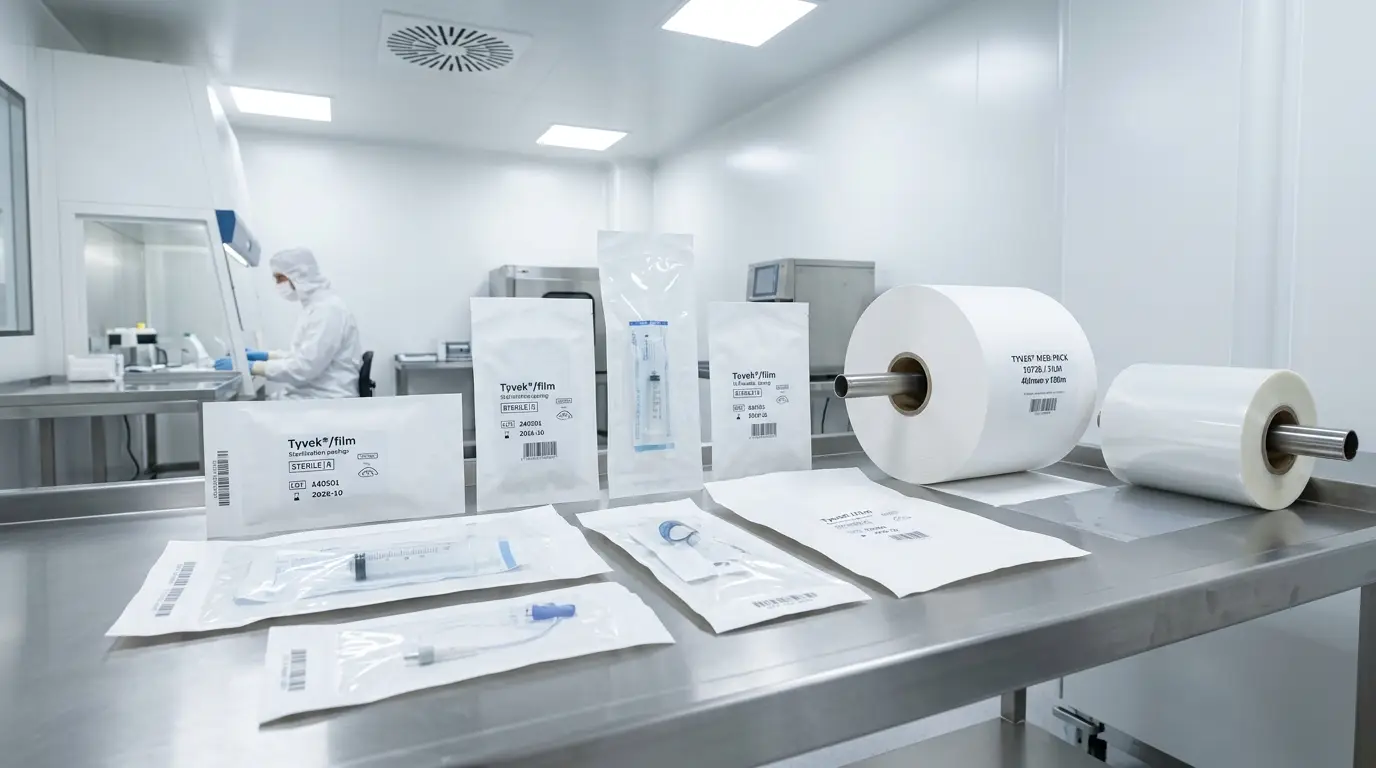
Tyvek & Medical-Grade Packaging Films
High-density polyethylene flash-spun nonwovens — the standard breathable sterile barrier material for medical device packaging worldwide.
What is Tyvek?
Tyvek (DuPont) is a flash-spun high-density polyethylene (HDPE) nonwoven fabric used as the breathable lidding material in peel pouches, header bags, and lidded trays for sterile medical devices. Its unique flash-spun microfibre structure provides a microbial barrier equivalent to HEPA filtration while allowing the passage of sterilant gases (EO, steam, H₂O₂ plasma) essential for terminal sterilisation.
Tyvek is the dominant breathable sterile barrier material globally, specified in ISO 11607-1 and validated under EN 868-9 (Tyvek pouches and header bags). It is used for everything from surgical instrument sets to diagnostic devices and combination products.
Tyvek Grades for Medical Packaging
| Grade | Weight (g/m²) | Thickness (µm) | Primary Application |
|---|---|---|---|
| Tyvek 1073B | 68 | 178 | Pouches, header bags — general medical devices |
| Tyvek 1059B | 68 | 152 | EO sterilisation — high porosity requirement |
| Tyvek 2FS | 68 | 165 | Lidded trays — improved formability |
| Tyvek 2FS coated | 80 | 190 | Heat-seal lidding for rigid trays |
Sterilisation Compatibility
Ethylene Oxide (EO)
Tyvek's primary advantage is high EO gas permeability — its porous structure allows rapid gas penetration and aeration. The material is fully compatible with EO sterilisation cycles including ISO 11135 standard processes. Tyvek maintains integrity through multiple EO cycles with no degradation at standard exposure conditions.
Gamma Irradiation
Tyvek is compatible with gamma irradiation up to 50 kGy without significant property change. Dose mapping studies should verify uniform dose delivery within packaged device systems. Some yellowing may occur at doses above 35 kGy but does not affect microbial barrier properties.
Steam (Autoclave)
Tyvek is NOT suitable for steam sterilisation — the HDPE fibres have a melting point of 130 °C, and standard autoclave cycles (121 °C/134 °C) will cause Tyvek to melt, distort, and fail as a microbial barrier. Steam-sterilised devices must use medical-grade paper or coated paper/film laminates.
H₂O₂ Plasma (VHP)
Tyvek is compatible with hydrogen peroxide vapour (VHP/VPHP) sterilisation processes. The nonwoven structure allows vapour penetration while maintaining microbial barrier integrity. Validate residual H₂O₂ levels on devices as Tyvek does not absorb peroxide like paper.
Medical-Grade Sealant Films
The film component of the pouch or header bag must be compatible with the Tyvek or paper lidding and form a hermetic, peelable seal. Standard medical sealant film structures include:
| Structure | Seal Temp (°C) | Sterilisation | Typical Application |
|---|---|---|---|
| PET/PE (clear) | 130–160 | EO, Gamma, VHP | Standard pouches, Class I devices |
| PETG/PE (enhanced seal) | 120–150 | EO, Gamma | Complex geometry devices |
| OPA/PE (oriented nylon) | 140–170 | EO, Gamma | Sharp-edged instruments, puncture risk |
| PET/Foil/PE | 140–170 | Gamma, EO | Moisture-sensitive electronics, implants |
| PP/PE (steam) | 160–190 | Steam, EO | Autoclave-compatible pouches |
Frequently Asked Questions
What peel force is required for medical device pouches?
ISO 11607-1 does not specify absolute peel force values — it requires that the package maintains integrity during distribution and sterilisation and opens in a controlled manner without contaminating the sterile field. Typically, peel forces of 1.5–4.0 N/15mm are targeted: sufficient to prevent accidental opening but easy enough for aseptic presentation. Peel force must be validated as part of the sterile barrier system qualification.
How do I validate Tyvek pouches for a new device?
Validation follows ISO 11607-2 and typically includes: package design qualification (testing seal strength, integrity, and burst resistance at minimum/maximum seal parameters), process qualification (IQ/OQ/PQ of sealing equipment), performance qualification (distribution simulation per ASTM D4169, sterility maintenance), and accelerated/real-time aging studies per ASTM F1980 and ISO 11607-1.
Can I use Tyvek for steam-sterilised devices?
No — Tyvek is incompatible with steam sterilisation. The HDPE microfibre structure melts at temperatures above 130 °C. For steam-sterilised devices, use medical-grade paper (EN 868-2) or paper/film pouches validated for steam sterilisation. Ensure the sealant film is also steam-compatible (PP/PE or foil-based structures are typical).