
Medical Device Packaging Design: ISO 14971 & Design Controls
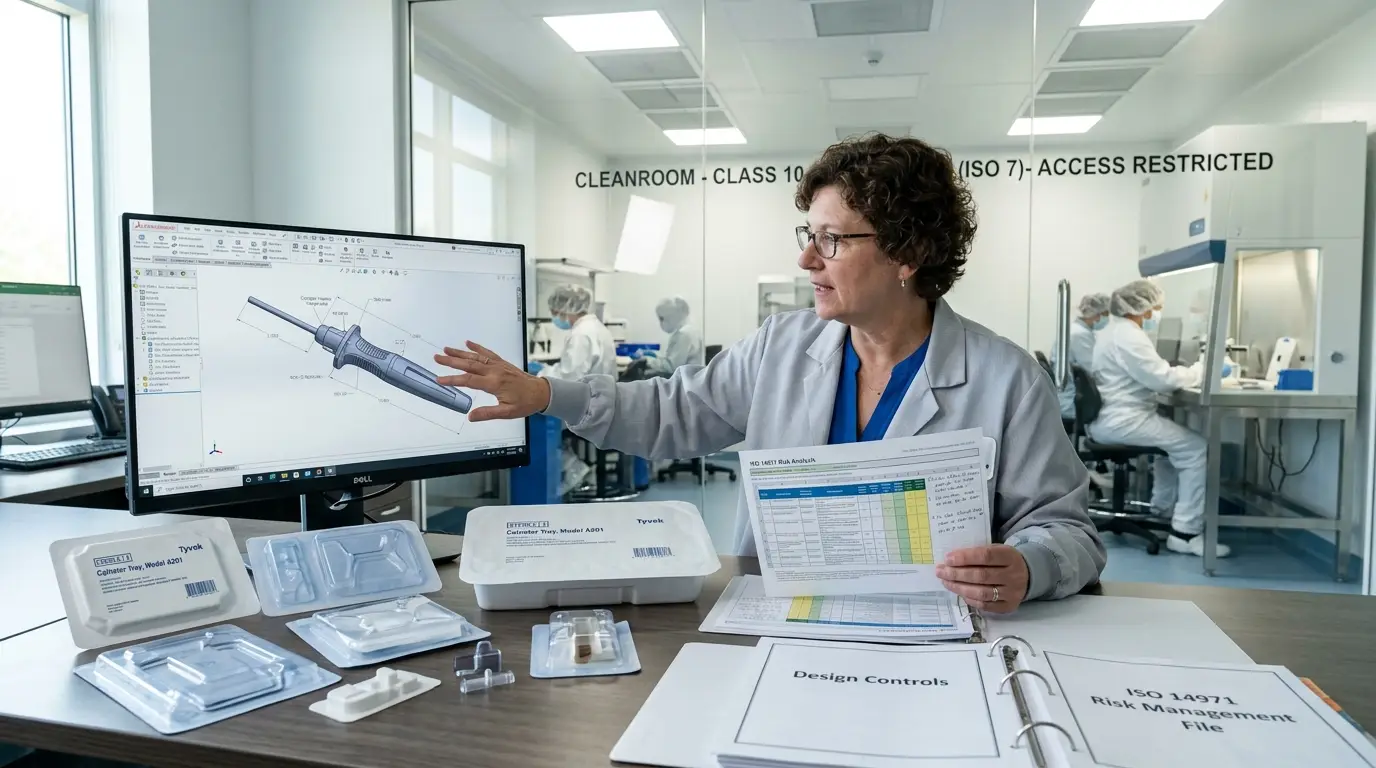
Medical Device Packaging Design: ISO 14971 & Design Controls
Medical device packaging design is a regulated activity — design controls, risk management, and design validation are mandatory requirements, not optional best practice.
Packaging as a Regulated Component
For medical devices, packaging is not a commodity — it is a regulated component of the medical device system. Under ISO 13485 and 21 CFR Part 820, the design and development of packaging must follow the same design control disciplines as the device itself: defined design inputs, documented design outputs, design review, design verification and validation, and design transfer to manufacturing. Packaging design failures are a major cause of regulatory non-conformance findings in medical device inspections and audits worldwide.
The Medical Packaging Design Process
1. Design Inputs (ISO 13485 §7.3.3)
Design inputs define the requirements the packaging must meet. For medical device packaging, mandatory inputs include: sterile barrier requirements (ISO 11607-1), sterilisation compatibility (EO, gamma, steam — per AAMI TIR17), distribution performance requirements (ASTM D4169 / ISTA), biocompatibility requirements (ISO 10993 for patient-contact packaging), and any specific regulatory requirements for the target market (EU MDR, US FDA, PMDA). All inputs must be documented and approved before design begins.
2. Risk Management Integration (ISO 14971)
ISO 14971:2019 requires a risk management process for the entire device lifecycle, explicitly including packaging. Packaging-specific risks to assess: failure of the sterile barrier (contamination, patient infection), loss of device protection (damage, compromised functionality), incorrect labelling (use error, wrong device), and packaging material interaction with device or sterilant. Risk controls (design changes, testing requirements, labelling) must be implemented and verified before design transfer.
3. Design Outputs & Specifications
Design outputs are the documented specifications that define the approved packaging design. Required outputs: material specifications (film structure, substrate, coating), dimensional drawings with tolerances (tray, pouch, carton geometry), sealing process parameters (temperature, dwell, pressure ranges), labelling requirements (content, placement, symbology per ISO 15223-1), and performance acceptance criteria (seal strength, integrity, distribution performance). Design outputs form the basis for process validation and manufacturing specifications.
4. Design Verification & Validation
Design verification confirms the design output meets the design input (testing against specifications). Design validation confirms the final packaging meets user needs and intended uses under simulated or actual conditions. For sterile barrier systems, validation includes accelerated aging studies (ASTM F1980 / ISO 11607-1 Annex C), real-time aging, distribution testing (ASTM D4169), and sterile barrier integrity testing. All validation testing must be conducted on production-equivalent samples, not prototypes.
Design for Manufacturability (DfM) for Sterile Packaging
| Design Decision | DfM Consideration | Consequence if Ignored |
|---|---|---|
| Tray flange width | Min. 6 mm for reliable Tyvek sealing | Seal integrity failures at corners and edges |
| Pouch seal width | Min. 8 mm for distribution survival | Delamination at ASTM D4169 vibration/drop |
| Device clearance in cavity | 1–3 mm per axis to avoid contact stress | Device damage during distribution |
| Peel tab geometry | Min. 20 mm pull tab on pouches and lids | Difficulty opening; contamination at aseptic presentation |
| Label panel area | Sufficient flat area for all required label content | Non-compliant labelling; regulatory rejection |
Labelling Requirements for Medical Device Packaging
Medical device packaging labelling must comply with EU MDR 2017/745 Annex I Section 23 and ISO 15223-1 (symbols for use on medical device labels). Mandatory label content includes: device name and model, unique device identifier (UDI) per EU MDR Article 27 (GS1 DataMatrix barcode from 2025 for all risk classes), manufacturer name and address, lot/batch number, expiry date, sterilisation method indicator, CE marking and notified body number (where applicable), and any required use instructions or warnings. Label placement and readability must be verified through accelerated aging — labels that are legible at manufacture must remain legible at end of claimed shelf life.
Frequently Asked Questions
Does packaging need to be included in the technical file under EU MDR?
Yes — packaging documentation is required in the technical file (General Safety and Performance Requirements per Annex I) and the design dossier. Required documentation includes: packaging design specifications and drawings, material specifications and declarations of conformity (food contact or biocompatibility where applicable), sterile barrier validation reports (ISO 11607-1/11607-2), labelling specifications and samples, and shelf life validation data. Gaps in packaging documentation are a common finding in EU MDR conformity assessment audits.
When should packaging design begin relative to device development?
Packaging design should be initiated concurrently with device design — not after the device design is frozen. Late-stage packaging decisions frequently create design constraints that force expensive compromises: a device designed without consideration of packaging geometry may require custom tooling, a device sterilised by a method not considered during packaging design may require a costly material change, or a device launched without adequate packaging distribution testing may fail in the field. The packaging designer should be part of the core development team from the design input stage.
What is accelerated aging and when is it needed?
Accelerated aging (ASTM F1980 / ISO 11607-1 Annex C) uses elevated temperature to simulate the natural aging of packaging materials and seals over the claimed shelf life. At 55°C, an accelerated aging factor of approximately 5x is applied — meaning 12 weeks of accelerated aging represents approximately 1.5 years of real-time aging at 23°C. Accelerated aging is used to claim shelf life before real-time data is available, enabling product launch. However, real-time aging studies must run concurrently and be completed before the claimed shelf life is reached. Any sterile packaged medical device with a shelf life claim requires either accelerated or real-time aging validation.