
IVD Packaging for Diagnostics & Reagents
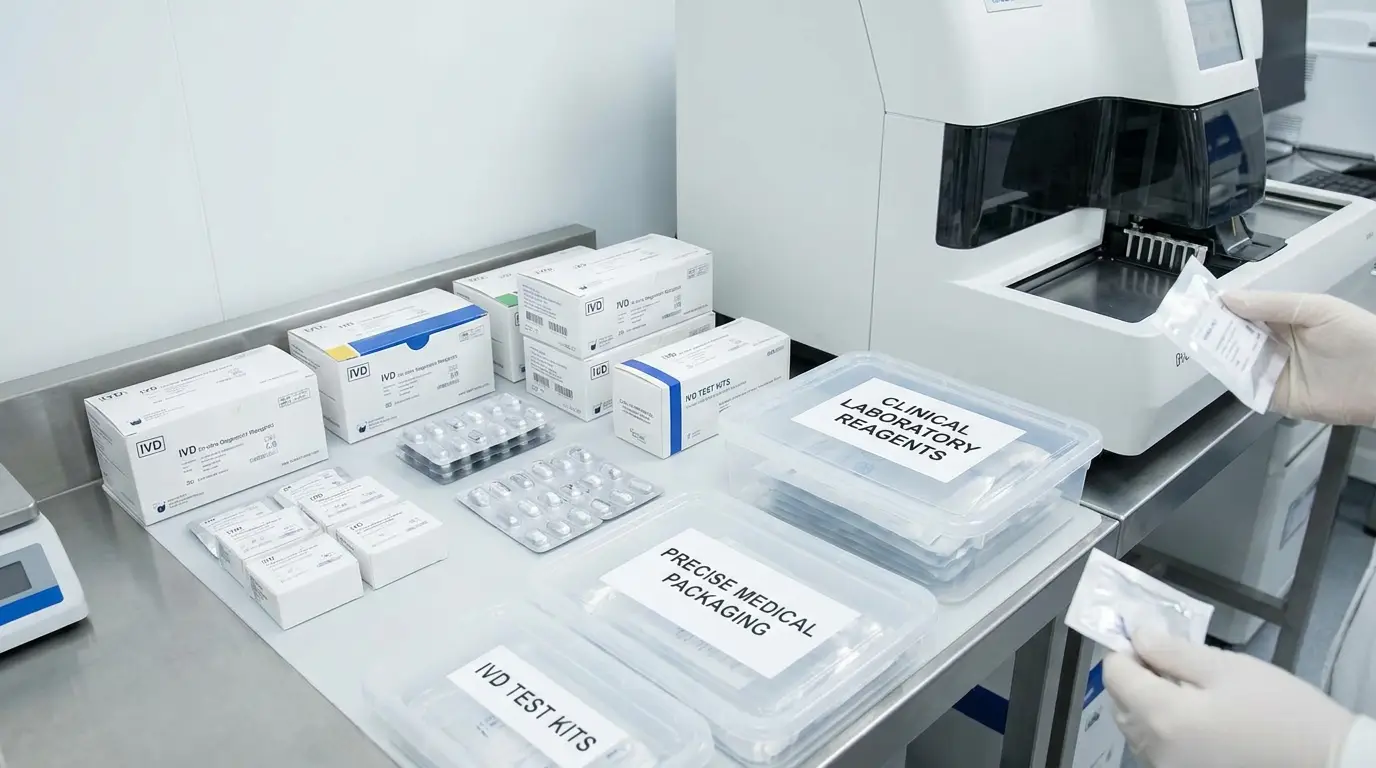
IVD Packaging: In Vitro Diagnostic Packaging Solutions
Specialised packaging for in vitro diagnostic test kits, reagents, and lateral flow assays — compliant with EU IVDR, ISO 18113, and diagnostic stability requirements
IVD Packaging: Unique Requirements and Challenges
In vitro diagnostic (IVD) packaging presents challenges distinct from other medical device packaging. IVD products — test kits, reagent cartridges, lateral flow assays, specimen collection systems, microfluidic chips, and laboratory consumables — contain biological or chemical components whose performance is exquisitely sensitive to moisture, temperature, and light exposure. A compromised IVD package can render a test invalid, with direct implications for patient diagnosis and clinical decision-making.
Unlike most medical devices where the packaging's primary function is sterility maintenance, IVD packaging must simultaneously: protect reactive chemistry from environmental degradation, maintain dimensional stability of precision diagnostic components, preserve the cold chain for temperature-sensitive reagents, and communicate complex Instructions for Use (IFU) and safety information across multiple languages and regulatory jurisdictions.
The regulatory framework for IVDs in Europe transitioned from the IVD Directive (98/79/EC) to the EU IVD Regulation (EU) 2017/746 (IVDR), which significantly strengthened classification, performance evaluation, and documentation requirements — including packaging documentation within the technical file.
IVD Product Categories and Packaging Requirements
Lateral Flow Assay (LFA) Kits
Lateral flow tests (pregnancy tests, COVID-19 antigen tests, flu tests, troponin kits) contain nitrocellulose membranes with lyophilised antibody conjugates that are acutely moisture-sensitive. LFA packaging typically uses: individual foil or desiccant pouches for each test strip, a desiccant sachet (silica gel or molecular sieve) inside the pouch, and a hermetically sealed outer foil laminate with very low WVTR (<0.1 g/m²/day). The foil laminate protects against moisture, oxygen, and light.
Reagent Cartridges and Enzyme-Based Kits
ELISA kits, PCR reagent sets, and immunoassay components contain enzymes, antibodies, and substrates that must be maintained within defined temperature ranges (typically 2–8°C) and away from freeze-thaw cycles. Packaging must provide thermal insulation for distribution, desiccation protection for lyophilised components, and physical protection for fragile microtitre plates and vials.
Point-of-Care (POC) Diagnostic Cartridges
Microfluidic and cartridge-based POC systems (blood gas analysers, coagulation monitors, molecular diagnostic cartridges) require packaging with electrostatic discharge (ESD) protection for embedded electronics, precision dimensional control to prevent cartridge deformation that would affect fluid channel geometry, and robust protection against transit shock and vibration.
Specimen Collection Systems
Blood collection tubes, swabs, urine specimen containers, and transport media packaging must maintain sterility (where required), prevent leakage of biological specimens, and comply with UN Dangerous Goods regulations for P650 (diagnostic specimens) classification for transport.
Regulatory Framework for IVD Packaging
IVD packaging must comply with multiple regulatory and standards requirements:
- EU IVDR (2017/746): Packaging must be documented in the technical file; labelling requirements under Annex I General Safety and Performance Requirements include language requirements, symbol use, and IFU accessibility. Notified body review is required for Class C and D IVDs.
- ISO 18113 series: Defines labelling requirements for IVDs — including vocabulary (Part 1), manufacturer's instructions (Part 2), labels (Part 3), reagent labels (Part 4), and self-testing products (Part 5)
- ISO 11607 (where applicable): IVDs supplied sterile (e.g. sterile specimen collection devices) must comply with ISO 11607 sterile barrier packaging requirements
- UN P650: Diagnostic specimen packaging for transport must meet the UN Packing Instruction P650 requirements under the International Air Transport Association (IATA) Dangerous Goods Regulations
- ICH Q5C / Q1A: For biological IVD components, stability testing must follow ICH guidelines, informing packaging requirements for protection against degradation pathways
Desiccants and Moisture Control in IVD Packaging
Moisture is the primary degradation driver for most LFA and enzymatic IVD components. Packaging moisture control uses:
- Desiccant sachets: Silica gel (broad-spectrum moisture absorption), molecular sieve (highly efficient at low humidity), and calcium chloride (high capacity) — selected based on the required equilibrium RH target
- Desiccant canisters: Integrated into the primary container (e.g. reagent tube closure caps) for reagent protection in multi-use products
- Foil barrier laminates: Primary moisture barrier at the packaging structure level — aluminium foil or EVOH-based laminates provide the hermetic perimeter
- Humidity indicator cards (HICs): Visual indicators placed inside the sealed package to confirm the desiccant is functional — changes colour if humidity exceeds threshold during storage or transport
Frequently Asked Questions
IVD packaging itself is not separately classified under IVDR — it is regulated as a component of the IVD product. The IVD's classification (Class A, B, C, or D under Annex VIII of IVDR 2017/746) determines the conformity assessment route for the complete product, including its packaging. Class C and D IVDs require notified body involvement. Packaging documentation forms part of the technical file required for all classes.
Only if the IVD itself is supplied sterile — for example, sterile specimen collection swabs, sterile blood collection tubes, or devices intended for use in sterile fields. Non-sterile IVD test kits, reagents, and cartridges do not require sterile barrier packaging, but do require packaging that protects the analytical performance of the reagents from moisture, temperature, and light degradation.
Stability studies (following ICH Q1A principles for biologics or manufacturer-defined protocols for chemical assays) characterise the degradation rate of the IVD's active components under defined temperature, humidity, and light conditions. The packaging system must provide sufficient barrier protection to maintain the IVD within its performance specification throughout the claimed shelf life and under the worst-case storage and distribution conditions described in the IFU.
ISO 18113-3 (labels) and 18113-2 (IFU) define minimum content for IVD packaging including: manufacturer name and address, product name and catalogue number, lot/batch number, expiry date, storage conditions, in vitro diagnostic device symbol (IVD symbol per ISO 7000-3077), language requirements for the intended market, and safety symbols. EU IVDR Annex I General Safety and Performance Requirements add further labelling obligations including language versioning for all EU member state languages.
IVD packaging is almost universally single-use, for reasons of sterility (where applicable), moisture control (desiccant is consumed), and regulatory traceability (lot number and expiry are tied to the specific package). Refillable IVD packaging would require validation that the packaging system can be adequately cleaned, re-desiccated, and re-qualified to meet the original performance specification — which is rarely commercially viable.
IVD Packaging ExpertiseDiscuss moisture protection, foil laminate selection, and IVDR compliance for your diagnostic product packaging.
Get in Touch →