
Medical Device Packaging Sealing Dies & Validated Tooling
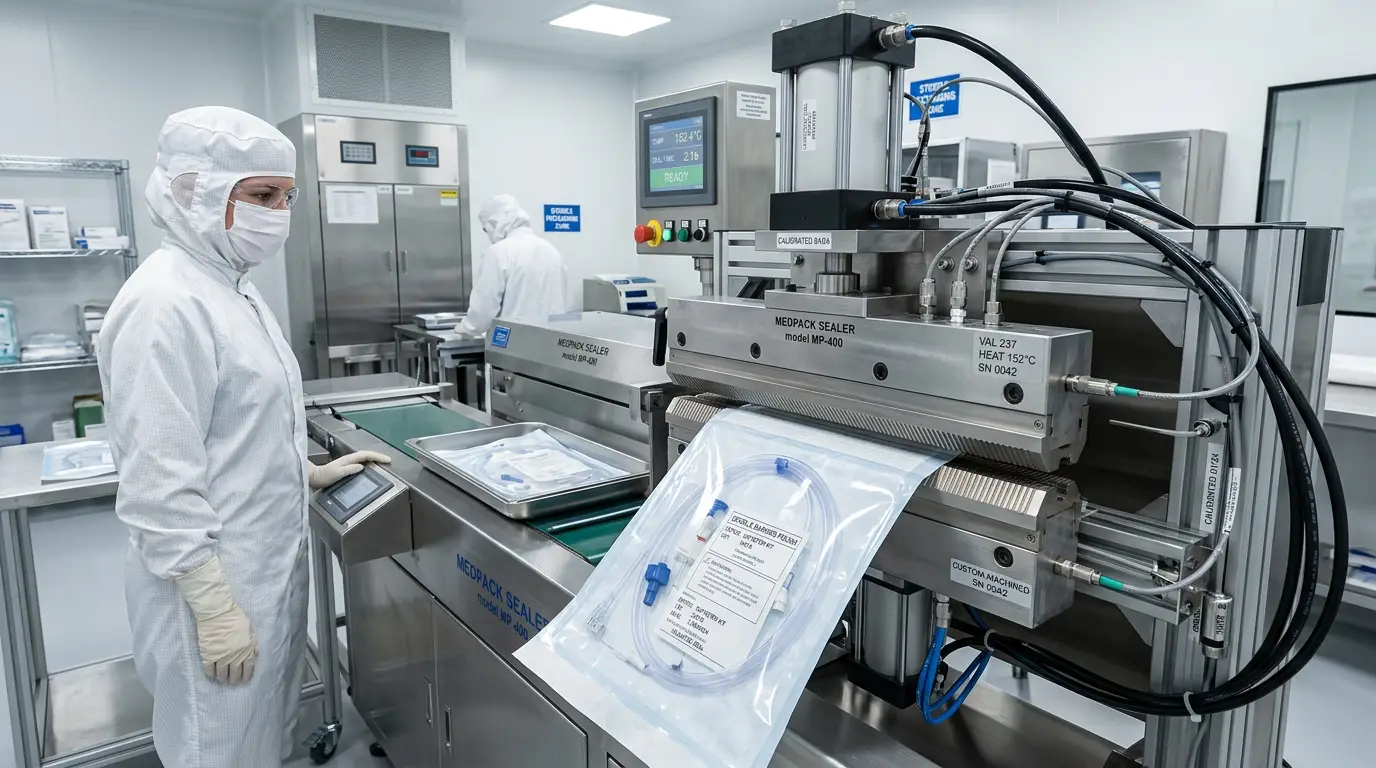
Medical Device Packaging Sealing Dies & Validated Tooling
Sealing tooling for medical packaging must be validated to ISO 11607-2 — every design and material choice has a direct impact on sterile barrier integrity and patient safety.
The Role of Sealing Dies in Sterile Barrier Systems
In medical device packaging, the sealing die is a critical process component. ISO 11607-2 requires that sealing equipment including tooling be documented, qualified, and maintained as part of the validated sealing process. Die geometry, material, surface finish, temperature uniformity, and pressure distribution all directly affect the seal width, seal strength, and hermetic integrity of the sterile barrier system (SBS). Any change to validated tooling requires formal change control and may trigger partial or full revalidation.
Sealing Die Types for Medical Packaging
Flat-Bed Sealing Dies (Pouch Lines)
Flat-bed sealing dies on medical pouch sealers apply heated jaws to form peel seals on Tyvek/LDPE or Tyvek/foil/LDPE pouches. Temperature uniformity across the full jaw length is critical — variation greater than ±3°C at the seal interface causes inconsistent peel force. Medical-grade sealing dies are calibrated against reference temperature standards traceable to national measurement standards (NIST, PTB).
Tray Sealing Dies (Lid Application)
For rigid thermoformed trays sealed with a Tyvek or film lid, the sealing die must uniformly press the lid film against the tray flange with consistent temperature and pressure. Die flatness and parallelism to the lower platen must be verified at IQ and periodically thereafter. Tray sealing dies are often product-specific — the die face geometry matches the tray flange profile to ensure consistent seal width at all points, including corners.
Form-Fill-Seal Sealing Jaws
Medical-grade FFS lines use sealing jaws validated to deliver consistent seal quality at defined line speeds. For medical device applications, jaw temperature, dwell time, and cooling are defined as critical process parameters (CPPs) with narrow acceptance windows established during OQ and confirmed during PQ with a minimum 3-run statistically sampled approach.
Ultrasonic Sealing for Contaminated Seals
Where product contamination of the seal area is unavoidable, ultrasonic sealing is preferred — the vibrating sonotrode generates heat only at the film interface, sealing through contamination with less than 100 ms cycle time. For medical applications, sonotrode calibration records (amplitude, frequency verification) must be included in the equipment qualification package.
Die Qualification Requirements (ISO 11607-2)
| Qualification Activity | What is Verified | Acceptance Criteria |
|---|---|---|
| IQ — Temperature uniformity | Actual temp across die face vs. setpoint | ±3°C max across full die length |
| IQ — Pressure calibration | Applied pressure vs. dial/display | ±5% of setpoint |
| OQ — CPP range determination | Temp/dwell/pressure at min/nom/max | Seal strength meets spec at all levels |
| PQ — Seal strength | Peel force (ASTM F88) at production speed | Min. 1.2 N/15mm Tyvek peel; hermetic seals per spec |
| PQ — Integrity | Dye penetration (ASTM F1929) or bubble emission | No dye ingress; zero visible bubbles at test pressure |
Frequently Asked Questions
Does changing a sealing die require revalidation?
Yes, in most cases. ISO 11607-2 requires formal change control for all equipment changes including tooling. Replacing a die with an identical part from the same supplier may require only a verification run confirming seal strength and integrity are within validated ranges. Changing die material, geometry, coating, or supplier typically requires a full OQ/PQ. Your change control procedure should define the decision criteria and required approval levels.
What seal strength is required for Tyvek medical pouches?
ISO 11607-1 does not specify a universal minimum — seal strength requirements are determined by design validation for the specific sterile barrier system. Practically, peel forces for Tyvek-to-polyethylene peelable seals of 1.0–3.5 N/15mm are typical, with the lower bound set to survive distribution and the upper bound set to allow clean peel presentation at point of use. These bounds must be formally established during design validation.
How is die temperature uniformity verified?
Temperature uniformity across a sealing die face is verified using a calibrated thermal survey — typically a multi-point thermocouple array or calibrated thermal imaging at steady-state operating temperature. Measurements are taken across the full die length and width at the operating setpoint. The survey is performed as part of IQ and repeated periodically (typically annually) or after any maintenance affecting temperature uniformity. Calibration traceability for all measurement equipment must be documented.