
Sterile Pouch Packaging for Medical Devices
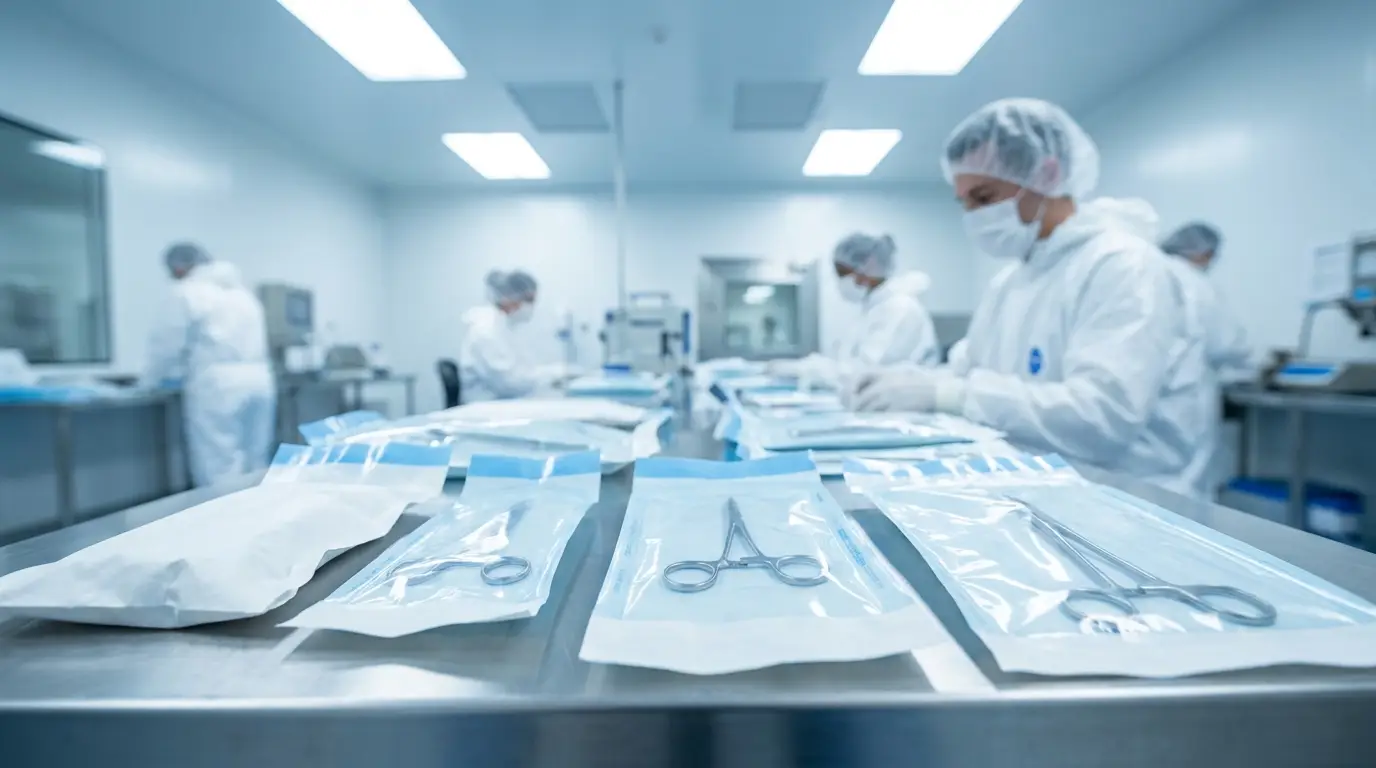
Sterile Pouch Packaging for Medical Devices
Validated Tyvek, paper, and film sterile pouches for single-use surgical instruments, implants, and medical devices — ISO 11607 compliant sterile barrier systems
What Is Sterile Pouch Packaging?
A sterile medical pouch is a flexible sealed package that forms the sterile barrier system (SBS) for single-use medical devices, surgical instruments, implants, and procedural components. It consists of two webs — typically one transparent film and one porous or opaque lidding material — heat-sealed on three or four sides to enclose the device in a validated sterile environment.
The pouch must maintain sterility from the point of sterilisation through transport, storage, and handling, right up to the moment of aseptic opening at point of care. ISO 11607-1:2019 governs the requirements for all materials, seal systems, and complete sterile barrier systems for terminally sterilised medical devices.
Sterile pouches are the most widely used primary packaging format for single-use medical devices globally — deployed for scalpels, forceps, catheters, sutures, wound dressings, orthopaedic components, electrosurgical accessories, and thousands of other device categories. Their combination of low cost, validated sterile barrier performance, and transparent presentation makes them the default choice for the vast majority of non-kit device packaging.
Pouch Materials: Tyvek, Paper, and Film Options
Tyvek Pouches
DuPont Tyvek is the industry standard porous material for ETO and gamma-compatible sterile pouches. Tyvek 1073B and 1059B provide excellent microbial barrier performance, consistent porosity for sterilant penetration, and a clean, lint-free peelable opening. The white Tyvek web is paired with a transparent coated polyester or PE film for device visibility.
Paper/Film Pouches
Medical-grade paper (Kraft or crepe) bonded with a heat-seal coating is a lower-cost alternative to Tyvek for ETO-compatible pouches. Paper pouches are widely used for instruments, implants, and devices where the additional strength of Tyvek is not required. Standard EN 868-3 defines requirements for paper used in medical packaging.
Transparent Film Pouches
All-film pouches (typically PET/PE or PET/PP) provide complete 360° device visibility and are used for gamma and e-beam sterilised devices. Both webs are non-porous, so the pouch must be sealed hermetically — ETO compatibility requires the sterilant to be applied before sealing or via a separate porous vent patch.
Seal Validation for Sterile Pouches
All sterile pouch sealing processes must be validated per ISO 11607-2:2019. The validation programme includes:
- Seal strength (ASTM F88): Peel force measured across the full seal width at minimum, nominal, and maximum process settings — establishes the validated process window
- Seal integrity (ASTM F1929 / ASTM F2096): Dye penetration and/or bubble leak testing to confirm no channels, voids, or incomplete seals across the pouch perimeter
- Accelerated ageing (ASTM F1980): Predicts shelf life performance under accelerated thermal conditions — typically 40°C/75% RH for 12 weeks to simulate 2 years of real-time ageing
- Distribution simulation (ASTM D4169): Vibration, shock, and compression testing to confirm packaging survives transit without integrity loss
- Sterilisation compatibility: Biological indicators for ETO, dose mapping for gamma/e-beam — confirming the pouch material survives the sterilisation process without degradation
Aseptic Opening and Presentation
A sterile pouch must not only maintain sterility in storage and transit — it must enable aseptic opening and device presentation at point of use without contaminating the sterile field. This requires:
- A consistent, controlled peel force that allows single-handed opening without tearing the Tyvek or creating particle contamination
- A clearly defined peel tab geometry that enables confident grip without touching the inner surface
- A 'chevron' or wave seal design at the peel initiation point to reduce the force required to start the peel
- Absence of delamination, fibre pull, or adhesive transfer that could contaminate the sterile device
Aseptic presentation validation is increasingly expected as part of the device's Design History File (DHF) and is addressed in FDA guidance on packaging validation and EU MDR technical file requirements.
Frequently Asked Questions
A sterile pouch is a flexible, flat package formed from two webs sealed on all four sides (or three sides with one folded edge). A blister pack has a pre-formed rigid cavity (the blister) sealed with a flat lidding material. Pouches are used for flexible devices, instruments, and items that don't require a shaped cavity. Blister packs are preferred when precise device positioning, higher rigidity, or better shelf presentation is required. Both must be validated to ISO 11607.
Tyvek pouches are compatible with ETO (ethylene oxide) — the porous Tyvek structure allows gas penetration while maintaining microbial barrier. They are also compatible with gamma irradiation (Tyvek is gamma-stable at standard doses of 25–45 kGy). E-beam sterilisation is also compatible. Tyvek is NOT compatible with steam autoclave sterilisation — the material distorts and loses its microbial barrier properties above ~100°C.
Shelf life is determined by validation, not by material properties alone. Most validated sterile pouches demonstrate shelf life of 2–5 years under controlled storage conditions (15–25°C, 40–60% RH, away from direct light). Shelf life validation uses ASTM F1980 accelerated ageing followed by integrity and seal strength testing. Real-time ageing studies run in parallel with accelerated studies to confirm results over time.
The three critical seal parameters are temperature (jaw temperature in °C), pressure (sealing jaw clamping force in N/cm²), and dwell time (time the jaws are closed in seconds). All three interact — lower temperature can be compensated by longer dwell time or higher pressure, within limits. The validated process window (minimum/maximum for each parameter) must be established during ISO 11607-2 process validation and maintained in production via documented control plans.
Yes — sterile pouches commonly include printed device identification, lot number, sterilisation method indicator (chemical indicator ink that changes colour post-sterilisation), expiry date, and UDI (Unique Device Identification) barcode/2D code. Printing must be compatible with the sterilisation method (ETO, gamma, steam) and must not affect seal integrity or barrier performance. Ink adhesion and legibility post-sterilisation should be verified during validation.
Sterile Pouch Packaging SolutionsDiscuss material selection, seal validation, and ISO 11607 compliance for your sterile pouch application.
Request Information →