
Sterile Barrier Packaging Laminates
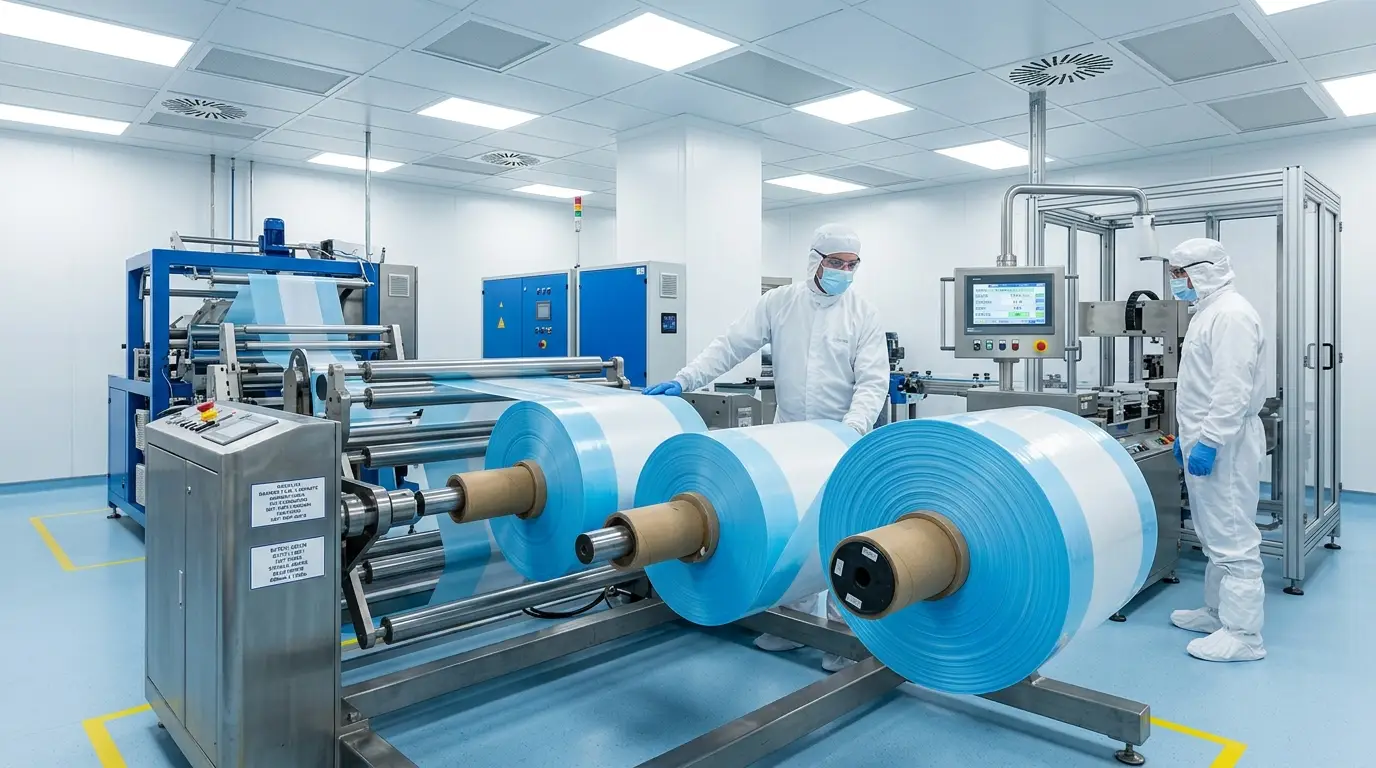
Sterile Barrier Packaging Laminates
Multilayer coextruded films that form the primary sterile barrier — engineered for microbial exclusion, seal integrity, and controlled aseptic presentation.
The Sterile Barrier System
ISO 11607-1 defines the sterile barrier system (SBS) as the minimum packaging required to prevent contamination of a sterile medical device. The SBS typically consists of a formed rigid component (PETG tray or cold-form foil) and a flexible lidding (Tyvek, paper/film, or foil laminate). Together, they must provide: microbial barrier, seal integrity throughout distribution and shelf life, and aseptic presentation (controlled, clean peel without touch contamination).
Sealant Layer Design
The sealant layer is the innermost layer of the flexible laminate — directly in contact with the device and forming the heat seal to the tray or co-web. It must balance seal strength, peel performance, and chemical compatibility:
PE-Based Sealants
LDPE, LLDPE, and mLLDPE sealants offer wide seal windows (110–150 °C), low seal initiation temperatures, and good compatibility with PETG, PP, and Tyvek substrates. mLLDPE provides superior hot-tack for high-speed sealing lines and better low-temperature seal strength.
Surlyn / Ionomer Sealants
Ionomer-based sealants provide exceptional clarity, grease resistance, and peel-ability from a wide range of substrates. Used in premium medical device pouches and combination product packaging where optical clarity of the seal area is required for QC inspection.
PP-Based Sealants
Required for steam-sterilised packages. PP sealants operate at higher temperatures (150–190 °C) and maintain seal integrity through 121–134 °C autoclave cycles. Crystalline PP provides high seal strength; PP random copolymers improve peelability.
Cohesive-Fail Peelable Sealants
Engineered to fail cohesively (within the sealant layer itself) rather than adhesively (at the substrate interface), providing consistent, clean peel without stringing or material transfer to the tray flange — critical for aseptic presentation of sterile devices.
Barrier Laminates for Implants and Long-Shelf-Life Devices
Implantable devices and combination products often specify 5-year shelf life at ambient conditions. Achieving this requires barrier laminates that maintain package integrity and sterility over extended periods. PET/EVOH/PE structures (OTR <2 cc/m²/day) or PET/foil/PE laminates (OTR ≈ 0) are standard choices, combined with accelerated aging studies (ASTM F1980) to demonstrate performance at real-time equivalents.
Frequently Asked Questions
What integrity tests are required for sterile barrier laminates?
ISO 11607-1 requires integrity testing of the finished package, not the raw laminate. Standard methods include dye penetration (ASTM F1929), bubble emission (ASTM F2096), vacuum and pressure decay (ASTM F2095), and microbial challenge testing for seal integrity qualification. Visual inspection is required for 100% production monitoring. Destructive peel testing (EN ISO 11607-1 Annex A) characterises seal strength distribution.
How do I select between Tyvek lidding and clear film lidding?
Use Tyvek for EO, gamma, and VHP sterilised devices where gas penetration is required and device visibility through the lid is not critical. Use clear film lids (PET/PE, OPA/PE) for gamma or VHP sterilised devices where device visibility through the lid is required for QC or end-user inspection. Steam-sterilised devices require paper or PP-based lids.
What is meant by 'aseptic presentation'?
Aseptic presentation refers to the ability to open the sterile package and transfer the device to the sterile field without contaminating it. The peel must be controlled, initiated from a defined tear notch or corner, and proceed without film delamination, stringing, or particle generation. ISO 11607-1 Annex B provides guidance on presentation requirements and testing methods.