
Medical Pouching Materials: Paper, Tyvek & Film Combinations
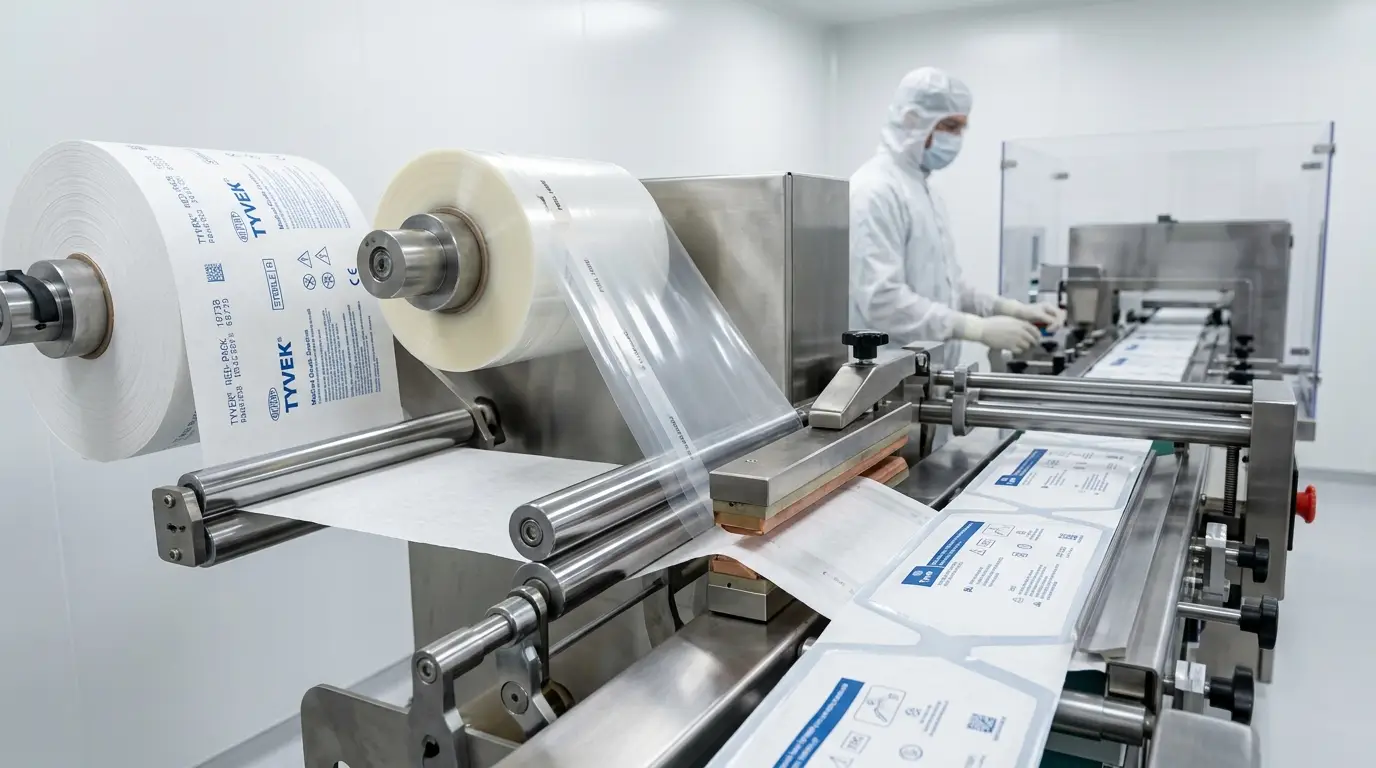
Medical Pouching Materials
Paper, Tyvek, and film combinations for peel pouches and header bags — the most widely used primary sterile packaging format for medical devices.
Pouch Construction Fundamentals
A medical peel pouch consists of two webs sealed together: one breathable (Tyvek or medical-grade paper) and one transparent film (PET/PE, OPA/PE, or foil laminate). This asymmetric construction provides both sterilant access and product visibility while maintaining microbial barrier through the full shelf life.
Pouches are available as pre-formed (flat or self-sealing), as rollstock for sealing on pouch sealers, and as chevron-sealed or side-sealed formats. The sealing format affects opening characteristics — chevron seals peel from the narrow end in a clean, controlled motion preferred for aseptic technique.
EN 868 Material Standards
| Standard | Material | Application |
|---|---|---|
| EN 868-2 | Sterilisation wrapping (paper) | Crepe wrap, CSR wrap |
| EN 868-3 | Paper bags for steam/EO | Small instrument bags |
| EN 868-4 | Paper bags for gamma/VHP | Radiation-sterilised devices |
| EN 868-5 | Sealable pouches & reels, paper/film | General surgical instruments |
| EN 868-9 | Tyvek uncoated pouches & reels | EO, gamma, VHP devices |
| EN 868-10 | Tyvek coated pouches & reels | Heat-sealed Tyvek packages |
Paper vs. Tyvek: Key Differences
Medical-Grade Paper (EN 868-2/5)
Crepe or flat paper with defined porosity, burst strength, and sterility maintenance. Compatible with steam, EO, and gamma sterilisation. Lower cost than Tyvek; more susceptible to moisture weakening and physical damage. Standard choice for CSSD (central sterile services) pouches that will be processed in hospital autoclave cycles.
Tyvek (EN 868-9/10)
Flash-spun HDPE nonwoven with superior tear and puncture resistance vs. paper. More consistent porosity, better moisture resistance, and longer shelf life stability. Not steam-compatible. Premium choice for high-value devices, long shelf-life requirements, and applications where packaging integrity during distribution is critical.
Pouch Sealers and Process Parameters
Medical pouches are sealed on rotary or flat-bed heat sealers at defined temperatures, pressures, and dwell times. Critical parameters per ISO 11607-2 include seal temperature uniformity (±2 °C across the seal bar), sealing pressure (2–5 bar), and dwell time (1–3 seconds). Seal bar calibration and monitoring records are mandatory for GMP compliance. Seal width should be minimum 6 mm for adequate strength and integrity testing access.
Frequently Asked Questions
What is the minimum seal width for medical pouches?
ISO 11607-1 does not mandate a minimum seal width numerically, but requires that the seal maintains integrity throughout the intended distribution and shelf-life period. In practice, 6 mm minimum seal width is widely adopted as providing adequate strength and a sufficient tab for integrity testing. Many device manufacturers specify 8–10 mm for robustness. The sealing process must be validated to demonstrate acceptable seal strength across the full width at minimum, nominal, and maximum process parameters.
How long can pre-formed pouches be stored before use?
Pouch materials (unprocessed rollstock or pre-formed pouches) typically have a shelf life of 3–5 years when stored at controlled conditions (15–25 °C, 30–65% RH) away from light and chemical vapours. This is distinct from the device shelf life — the package must maintain sterility from the point of sterilisation through the device's claimed shelf life, validated per ASTM F1980 accelerated aging or real-time studies.
Can I use generic pouches from non-registered suppliers?
Under EU MDR and 21 CFR Part 820, packaging materials must be controlled components with defined specifications, supplier qualification, and incoming material testing. Using generic pouches without EN 868 certification, CoA documentation, and supplier audit is a quality system non-conformance. Materials must be part of the Device History Record and Technical File documentation.