
Medical & Pharma Blister Tooling: GMP Format Parts Guide
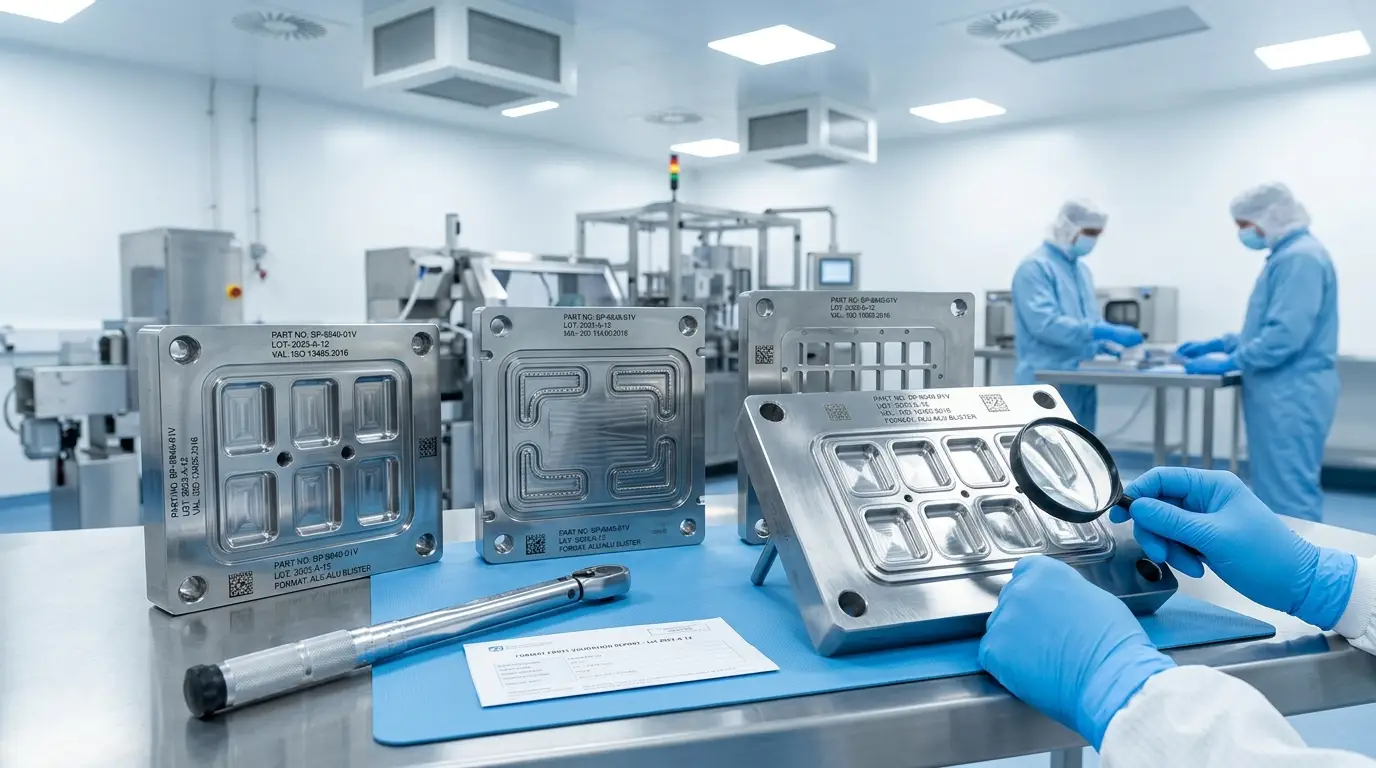
Medical & Pharma Blister Tooling: GMP Format Parts Guide
Blister tooling for medical and pharmaceutical applications must satisfy GMP documentation, validation, and traceability requirements that go well beyond standard packaging tooling practice.
Blister Formats in Medical and Pharma Applications
PVC/PVDC Thermoform Blister (Pharma)
The standard pharmaceutical solid-dosage blister uses a PVC or PVC/PVDC web thermoformed into cavities matching tablet or capsule geometry, sealed with aluminium lidding foil. Tooling is product-specific. GMP requires tooling to be individually identified, maintained in dedicated storage, and reconciled against production records for each batch.
Alu-Alu Cold-Form Blister (CFF)
For moisture-sensitive pharmaceuticals, cold-form foil (CFF) blisters using OPA/aluminium/PVC provide superior barrier properties. CFF tooling uses a cold-forming punch and die — no heated forming. Die clearance must be controlled to ±0.02 mm to prevent foil pinholing which would compromise moisture barrier integrity. All CFF tooling must be validated with WVTR testing confirming barrier integrity of the formed blister.
Medical Device Blisters
Single-use medical devices (test kits, lancets, disposable instruments) are frequently blister-packed using transparent PET or PETG forming films sealed with printed Tyvek or paper/foil lidding. These blisters function as sterile barrier systems subject to ISO 11607-1/11607-2. Device blister tooling must be qualified as packaging equipment; device cavity dimensions must be validated for device retention during distribution testing.
Ophthalmic and Implant Packaging
Contact lenses and small implants use blister or pre-formed cup formats sealed under specific environmental conditions. Tooling for these applications must be compatible with cleanroom manufacturing (typically ISO Class 7 or 8). Tool materials and surface finishes must be compatible with WFI rinsing and validated cleaning procedures.
GMP Tooling Identification and Control
| Control Element | GMP Requirement | Implementation |
|---|---|---|
| Tooling identification | Each tool uniquely identified | Engraved or laser-marked tool number + product code |
| Tooling qualification | IQ/OQ/PQ per equipment qualification SOP | Protocol + report in equipment master file |
| Tooling change control | Formal change control for all modifications | Change control form + impact assessment + approval |
| Maintenance records | Log of all maintenance activities per tool | Equipment logbook or electronic QMS record |
| Tooling storage | Defined storage conditions and cleanliness | Dedicated rack/cabinet, cleaning before storage |
Validation of Blister Sealing Tooling
Blister sealing plate qualification under ISO 11607-2 or GMP follows the IQ/OQ/PQ model. Critical parameters: temperature (setpoint vs. actual across the full sealing plate area), pressure (uniform contact at all points), and dwell time. The OQ establishes the proven acceptable range (PAR) for each parameter. PQ demonstrates three production batches at worst-case process conditions consistently produce blisters with seal integrity and visual appearance within specification.
Frequently Asked Questions
How is blister tooling cleaned in a GMP environment?
Blister tooling cleaning procedures must be validated per GMP requirements. Validated procedures define: cleaning agent (pharmaceutical-grade IPA or WFI), cleaning method (manual wipe, ultrasonic bath, or CIP system), contact time and temperature, residue limits validated by swab or rinse sample analysis, and drying requirements before storage or reinstallation. Cleaning validation records must be maintained in the equipment file and reviewed during GMP audits.
What changes to blister tooling require revalidation?
Under GMP change control, changes requiring revalidation include: replacement of sealing plate or forming die (even with identical spare), modification to cavity geometry or sealing surface, change of tooling material or surface coating, and reassignment of tooling from one product to another. Changes that may require only verification include repair of minor cosmetic damage not affecting the sealing surface, replacement of secondary components, and calibration adjustments within the validated range.
Can blister tooling be shared across products?
Shared tooling is possible where cavity dimensions are compatible across products, but carries GMP risks including cross-contamination risk requiring validated cleaning between products, and potential for wrong-product error if identification is inadequate. Most pharmaceutical manufacturers use product-dedicated tooling for primary packaging to eliminate cross-contamination risk and simplify tooling management in the QMS.