
Cold Chain Packaging Materials: PCM, VIP and Thermal Insulation
Cold Chain Packaging Materials
PCM panels, vacuum insulated panels, and validated thermal systems that maintain temperature integrity for biologics, vaccines, and medical devices.
Cold Chain Packaging Material Categories
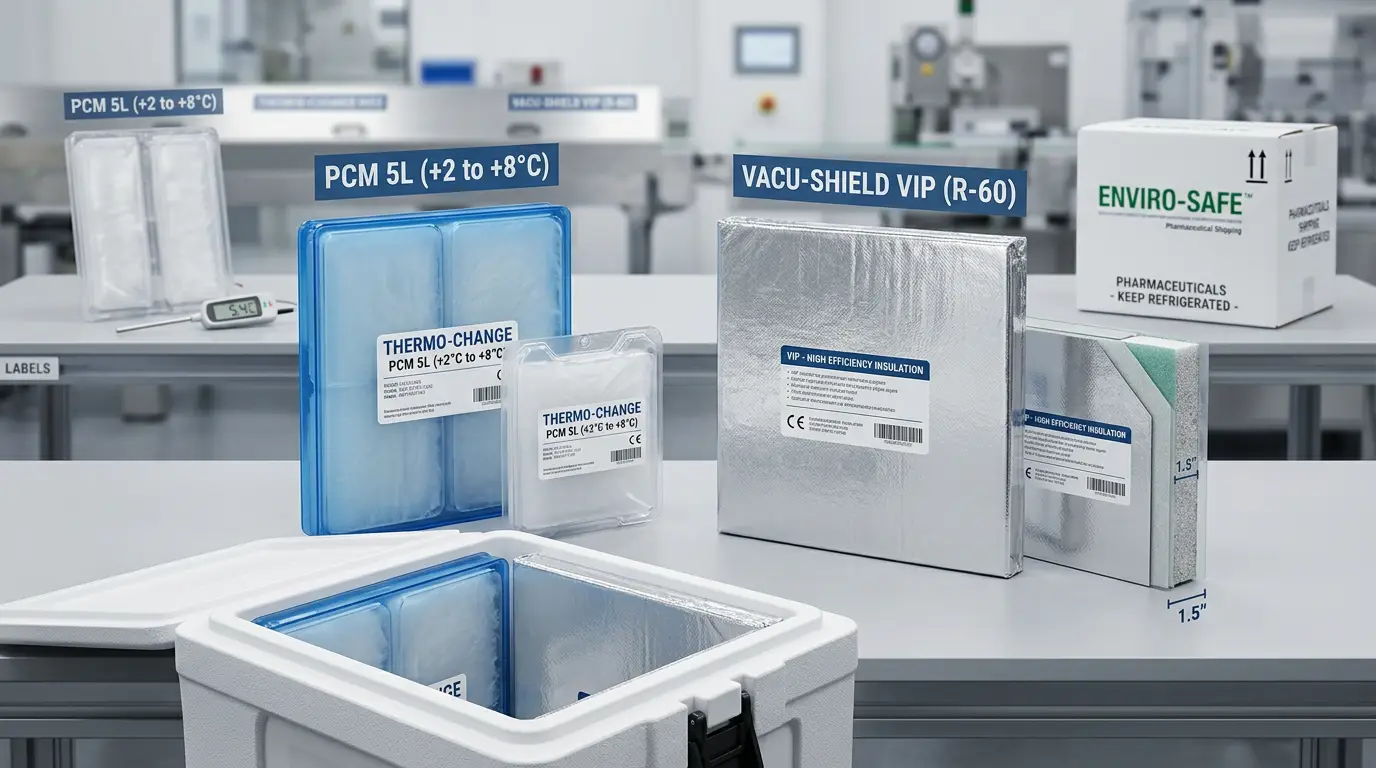
Temperature-controlled pharmaceutical and medical packaging requires a combination of thermal insulation and temperature-regulation materials. The three primary categories are: phase change materials (PCM) that absorb and release latent heat at a defined transition temperature; vacuum insulated panels (VIP) that provide extremely low thermal conductivity; and conventional foam insulators (EPS, PUR) that provide cost-effective bulk insulation.
Phase Change Materials (PCM)
PCMs absorb or release large amounts of latent heat as they transition between solid and liquid phases at a defined melting point. This isothermal behaviour allows PCM-based packaging to maintain a precise temperature range for hours to days without active refrigeration. PCM selection is determined by the required temperature profile:
| Temperature Profile | PCM Type | Transition Temp (°C) | Application |
|---|---|---|---|
| 2–8 °C (refrigerated) | Water-based or salt hydrate | 5–6 °C | Biologics, vaccines, insulin |
| 15–25 °C (controlled room temp) | Organic PCM (paraffin) | 18–22 °C | Oral drugs, diagnostic kits |
| −20 °C (frozen) | Eutectic salt solution | −21 °C | Frozen biologics, plasma |
| −80 °C (ultra-cold) | Dry ice / specialised PCM | −78.5 °C | mRNA vaccines, cell therapy |
Vacuum Insulated Panels (VIP)
VIPs consist of a microporous fumed silica or glass fibre core evacuated to below 10 mbar and sealed in a gas-barrier metallised laminate envelope. At this vacuum level, VIPs achieve thermal conductivity of 5–8 mW/m·K — 5–10× better than EPS — enabling thinner, lighter packaging solutions for the same temperature-hold performance.
Advantages
Dramatic reduction in package volume and weight vs. EPS — critical for high-value biologics where freight cost is significant. Enables 24–96 hour temperature excursion windows with panels 25–40 mm thick. Reusable in qualified closed-loop distribution networks.
Limitations
High unit cost ($15–60/panel) limits use to high-value, temperature-sensitive products. VIPs are susceptible to puncture — loss of vacuum immediately eliminates the insulation advantage. Panel integrity must be verified before each use in reusable systems. Not suitable for disposal in standard waste streams (fumed silica core requires specialist handling).
GDP Compliance and Validation
EU Good Distribution Practice (GDP Guidelines 2013/C 343/01) and WHO Technical Report 961 require that temperature-sensitive pharmaceutical products are transported in validated packaging systems. Validation typically includes summer (worst-case warm) and winter (worst-case cold) performance qualification studies using representative distribution routes, with temperature data loggers recording payload temperature throughout. The packaging system qualification must be reviewed when route, season, product, or packaging configuration changes.
Frequently Asked Questions
How long can PCM packaging maintain 2–8 °C?
Performance depends on PCM mass, insulation R-value, ambient temperature, and payload thermal mass. Typical validated configurations for 2–8 °C profiles achieve 24–96 hours at 25 °C ambient (summer condition) and 48–120 hours at 5 °C ambient (winter condition). Systems validated for 96+ hours at 40 °C ambient (extreme summer) use VIP insulation with PCM and can achieve 100+ hour profiles. Always rely on validated performance data specific to the packaging configuration and seasonal conditions.
Can dry ice be used for 2–8 °C shipping?
No — dry ice (−78.5 °C) is used exclusively for ultra-cold products (mRNA vaccines, cell therapy) and frozen biologics (−20 °C). Direct contact between dry ice and 2–8 °C products will cause freezing damage. For refrigerated products, use 5–8 °C PCM panels or qualified gel packs (NOT standard water-ice, which transitions at 0 °C and can cause cold excursions below 2 °C).
What documentation is required for cold chain packaging validation?
GDP validation documentation typically includes: packaging system design qualification (DQ), installation qualification (IQ) of temperature monitoring equipment, operational qualification (OQ) at defined temperature profiles with controlled climate chambers, performance qualification (PQ) using actual or simulated distribution routes, and a qualification report with acceptance criteria sign-off. All studies must be performed with temperature data loggers calibrated to NIST-traceable standards.