
Rigid Forming Webs for Medical Device Packaging
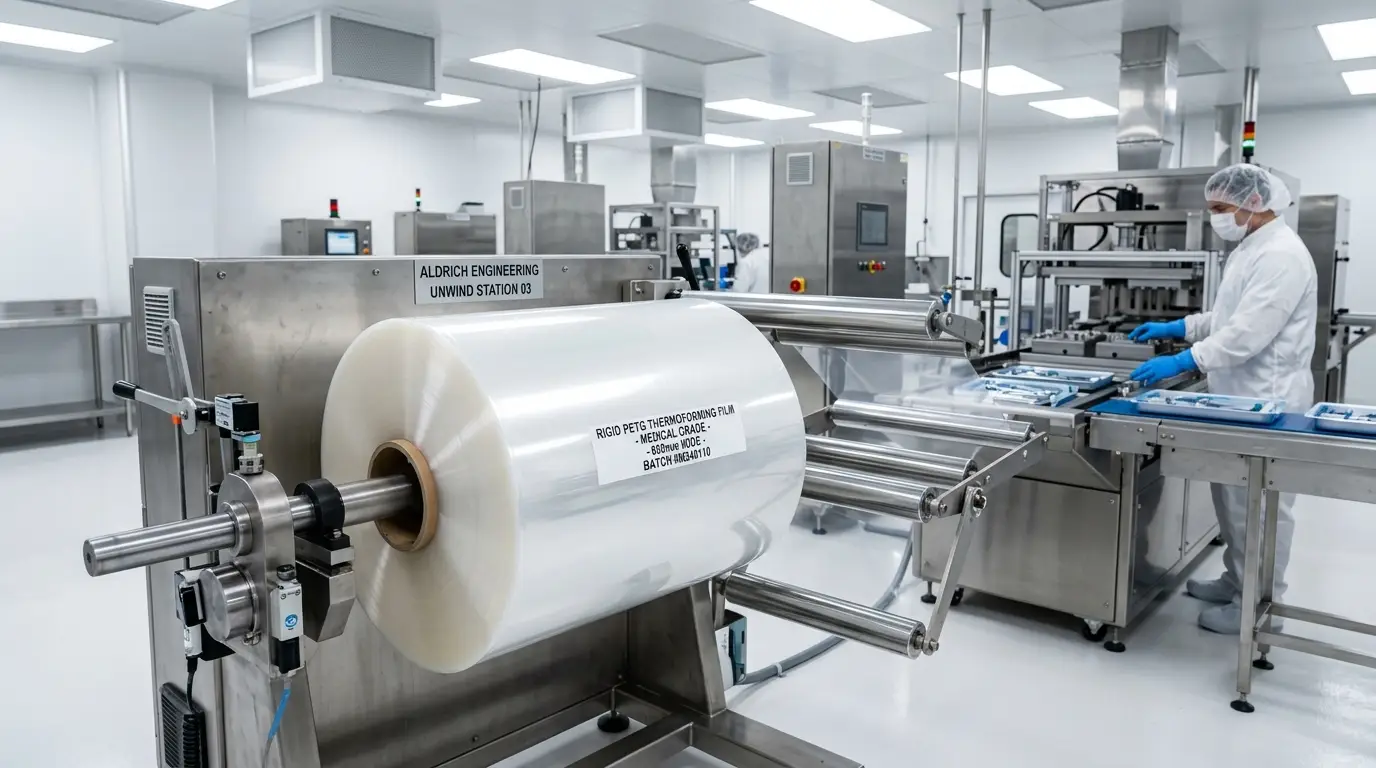
Rigid Forming Webs for Medical Device Packaging
PETG, PCTFE, PVDC, and PVC — thermoformable base webs that define tray geometry, clarity, and barrier performance.
Role of Rigid Forming Webs
In blister and lidded tray packaging for medical devices, the forming web is thermoformed under heat and vacuum (or pressure) to create cavities that hold and protect the device. Forming web selection determines cavity depth-to-diameter draw ratio, transparency for device inspection, moisture and oxygen barrier, sterilisation compatibility, and biocompatibility requirements per ISO 10993.
Material Comparison
| Material | WVTR (g/m²/day) | OTR (cc/m²/day) | Sterilisation | Transparency |
|---|---|---|---|---|
| PETG (250 µm) | 2–4 | 20–40 | EO, Gamma, VHP | Excellent |
| PVC (250 µm) | 3–6 | 30–60 | EO, Gamma (limited) | Good |
| PVDC/PVC (250 µm) | 0.5–1.5 | 3–8 | EO, Gamma | Good |
| PCTFE/PE (200 µm) | 0.05–0.15 | 5–15 | EO, Gamma, Steam | Good |
| PP (400 µm) | 0.5–1.5 | 100–300 | Steam, EO, Gamma | Moderate |
PETG — The Standard Medical Grade
Glycol-modified PET (PETG) is the dominant rigid forming web for medical device trays and blisters. Its excellent thermoformability, high clarity, gamma compatibility, and low migration profile make it the default choice for Class I–III devices. PETG draws uniformly to depth-to-diameter ratios of up to 0.7:1 and seals cleanly to Tyvek and PET/PE film lids.
PCTFE — Ultra-Low Moisture Barrier
Polychlorotrifluoroethylene (PCTFE), marketed as Aclar (Honeywell), provides the highest moisture barrier available in a transparent thermoformable film — 5–20× better than PVDC and suitable for the most moisture-sensitive pharmaceuticals and IVD reagents. PCTFE is significantly more expensive than PETG or PVC but enables ambient storage for products that would otherwise require controlled climate shipping.
Frequently Asked Questions
Can PETG be used for steam-sterilised devices?
Standard PETG has a heat distortion temperature of approximately 70–80 °C, making it unsuitable for autoclave cycles at 121 °C or 134 °C. For steam-sterilised devices, use polypropylene (PP) forming webs, which are routinely sterilised at 121 °C. High-temperature PETG grades and APET with specific crystallisation treatments can tolerate limited steam exposure but should be validated specifically for the intended sterilisation cycle.
What draw ratio can PETG achieve in thermoforming?
Standard PETG achieves draw ratios (cavity depth:diameter) of 0.5:1 to 0.7:1 with uniform wall distribution using vacuum forming. Pressure-assisted forming or plug-assist tooling extends this to 0.8:1–1.0:1. Draw ratio limits depend on gauge, forming temperature, tool geometry, and production speed. Finite element simulation (FEA) is used in tray design to predict wall thinning at critical corners.
Is PVC being phased out in medical device packaging?
PVC is under increasing regulatory and sustainability pressure due to plasticiser (DEHP/DINP) migration concerns and chlorine content. EU MDR Annex I requires justification for DEHP-containing packaging in contact with patient-contact devices. However, PVC is not banned in medical packaging and remains widely used where PETG or PP alternatives have not been validated. New installations are increasingly specifying PETG or PP to future-proof compliance.